What Every WordPress Maintenance Contract Must Include
Your WordPress site just went down at 2 AM. Plugins are conflicting, the backup is outdated, and you have no idea who is responsible for fixing it. Sound familiar? This is exactly the situation a well-structured wordpress website maintenance contract is designed to prevent.
Whether you are a freelancer managing client sites or a business owner hiring a developer, the contract you sign determines who does what, when, and for how much. A vague agreement leaves both parties vulnerable to misunderstandings, scope creep, and costly disputes. A strong one creates clarity, accountability, and peace of mind.
But not all maintenance contracts are created equal. Many miss critical components that only become apparent when something goes wrong. In this post, we break down the essential elements every WordPress maintenance contract must include. From security monitoring and update schedules to response time guarantees and payment terms, you will walk away knowing exactly what to look for, what to ask for, and what to never sign without. Let’s make sure your next contract actually protects you.
Why a Formal Maintenance Contract Matters More Than Ever
If your WordPress site is still running on an informal “we’ll fix it when something breaks” arrangement, the data from 2025 and 2026 makes a compelling case for rethinking that approach. WordPress now powers 43.5% of all websites globally, representing more than 63 million active sites. That extraordinary reach makes it the single largest attack surface on the internet, with automated bots constantly scanning installations for weaknesses in plugins, themes, and core files around the clock.
The vulnerability landscape has grown sharply more dangerous. In 2025 alone, the WordPress ecosystem recorded 11,334 new vulnerabilities, a 42% year-over-year increase. Over 6,700 of those emerged in just the first half of the year, meaning new exploitable weaknesses were surfacing at a rate of roughly 37 per day. The majority originate from third-party plugins and themes rather than WordPress core itself, and many are exploited within hours of disclosure. For site owners relying on ad hoc updates, that window is rarely enough time to act.
This is precisely where a formal wordpress website maintenance contract creates measurable protection. Over 70% of WordPress sites remain vulnerable due to outdated plugins and themes. A structured agreement directly addresses this by mandating regular, staged, and tested updates on a defined schedule, removing the guesswork and delay that leaves sites exposed.
The financial argument is equally straightforward. The average cost to recover from a WordPress security breach sits at approximately $14,500, factoring in cleanup, restoration, downtime, and reputational damage. A professional maintenance plan in Australia typically runs $100 to $300 per month, representing a fraction of that recovery cost for continuous, proactive protection.
Finally, the broader market signals that ongoing site management is becoming a business standard rather than an optional extra. The global website maintenance services market was valued at $14.8 billion in 2025 and is projected to reach $36.2 billion by 2034, growing at a 10.5% compound annual rate. Businesses across every sector are recognising that a website is not a one-time project but an ongoing operational asset requiring structured, accountable care to remain secure, fast, and reliable.
What a WordPress Website Maintenance Contract Actually Is
A WordPress website maintenance contract (also known as a care plan, maintenance agreement, or support retainer) is a formal, recurring service agreement between a site owner and a provider that defines exactly who is responsible for keeping a site secure, updated, backed up, and performing reliably. Rather than treating post-launch support as an informal arrangement, this type of agreement puts obligations, deliverables, and expectations in writing on both sides. Think of it as an operational guarantee for a live digital product, one that closes the gap between the day a site goes live and every day it needs to function without interruption.
Unlike a fixed-scope project contract with a defined end date, a maintenance agreement is ongoing by design. It includes a structured billing cycle (typically monthly, quarterly, or annually), defined response time obligations through service level agreements, and a regular reporting cadence that keeps clients informed on updates performed, threats resolved, and uptime metrics. According to a comprehensive guide to WordPress maintenance contracts, this structure creates mutual accountability that an informal “fix it when it breaks” approach simply cannot replicate.
The contract establishes the operational baseline for a live product. Core inclusions typically cover WordPress core, plugin, and theme updates tested in a staging environment; daily or weekly backups with documented restoration procedures; security monitoring and malware removal; uptime tracking; and monthly performance reporting. Exclusions are equally important, and well-drafted maintenance agreement templates consistently exclude major redesigns, new feature development, content creation, and large-scale migrations, each treated as a separate scoped project.
For studios like Pixeldev, maintenance contracts represent the structured “operate” phase of a discovery, build, and operate model. Rather than treating post-launch support as an optional add-on, this approach integrates ongoing maintenance as a deliberately designed service from the outset. That distinction matters: clients receive a partner invested in the long-term health of their product, not a reactive vendor waiting for something to break.
A well-structured agreement also functions as a scope management tool. By explicitly listing what is and is not covered under the monthly fee, it reduces scope creep, prevents misaligned expectations, and gives clients complete transparency over the value they receive each billing cycle.
1. Core Services: The Non-Negotiable Inclusions
Not every item on a maintenance plan deserves equal weight. Some services are genuinely optional enhancements; others are the structural foundation that keeps a WordPress site functional, secure, and recoverable. The six inclusions below fall firmly in the second category. If a contract you’re reviewing doesn’t address all of them explicitly, that’s a gap worth negotiating before you sign.
1. Staged Updates for WordPress Core, Plugins, and Themes
Applying updates directly to a live site is one of the most common and avoidable causes of WordPress downtime. A well-structured contract mandates that all core, plugin, and theme updates are first applied to a staging environment, a private clone of the production site, where compatibility is verified before anything goes live. This matters because over 70% of WordPress sites remain vulnerable due to outdated plugins and themes, yet pushing unverified updates can cause its own category of breakage. The contract should specify the testing protocol (visual checks, functional testing, form submissions), the rollback procedure if an issue is detected, and the timeframe within which security patches are applied, typically within 24 hours of release for critical vulnerabilities.
2. Automated Backups with Verified Restoration
A backup that has never been tested is not a backup strategy; it’s a false sense of security. Your contract should specify daily automated backups as the baseline for any active business site, with off-site or cloud storage kept separately from the hosting server. Beyond frequency, the contract needs to define the retention period (30 days is a reasonable minimum), the tested restoration process, and a maximum restoration time SLA. Some providers phrase this loosely; insist on explicit language that covers how often restore tests are performed and what the recovery time commitment actually is.
3. Security Monitoring with a Defined Incident Response
With over 11,334 new WordPress vulnerabilities recorded in 2025, reactive security is simply not sufficient. A contract’s security inclusion should cover real-time or daily malware scanning, web application firewall rules, login protection such as rate limiting and two-factor authentication, and file-change detection. Critically, it should also define the response procedure: who is notified when a threat is detected, within what timeframe, and what actions are taken (quarantine, cleanup, client notification). Vague language like “we monitor your site for issues” provides no accountability.
4. Uptime Monitoring with Automated Alerting
Continuous uptime monitoring with checks every one to five minutes ensures that downtime is caught by your provider before a customer reports it. The contract should name the monitoring tool used, define the alerting threshold, and specify the notification channels (email, SMS, or a dedicated communication platform). Response time commitments tied to uptime alerts, for example, acknowledgement within 30 minutes for critical downtime, are what separate accountable plans from passive ones.
5. Monthly Performance Checks Including Core Web Vitals
Performance is not a one-time optimisation. As plugins accumulate and content grows, page speed and Core Web Vitals scores drift. Only around 44% of WordPress sites passed all three Core Web Vitals on mobile as of late 2025, a direct ranking and conversion risk. Your contract should include monthly page speed audits, LCP, INP, and CLS tracking, and require that all optimisations and changes are logged in the monthly report so progress is measurable over time.
6. Minor Content and Technical Fixes with Clear Scope Limits
Mid-tier and above plans typically include a defined allocation for small, time-bounded tasks such as fixing broken links, resolving form errors, or swapping out images. The key is specificity: the contract should define what qualifies as a minor fix (generally under 30 to 60 minutes with no new development required), the maximum monthly hours included, and what falls outside this scope and would be quoted separately. Without this definition, both parties are exposed to mismatched expectations and scope creep.
Together, these six services form the non-negotiable baseline of any credible WordPress website maintenance contract. Treat any plan that omits or vaguely defines them as incomplete until the gaps are addressed in writing.
2. Exclusions: What the Contract Should Explicitly Not Cover
Knowing what your maintenance contract does cover is only half the equation. Equally important is knowing what it explicitly does not cover, and making sure that boundary is written into the agreement in plain terms.
Major redesigns, new page development, and structural changes are among the most common sources of scope creep in maintenance engagements. A maintenance plan is designed to preserve and protect the site as it currently exists; it is not a licence for ongoing feature expansion or visual overhauls. If a client wants to add a new service section, rebuild their navigation structure, or refresh the entire design language, that work should be scoped, priced, and contracted separately. Understanding what falls inside and outside a maintenance package is essential for both parties before the retainer is signed, not after a dispute arises.
Content creation, copywriting, SEO strategy, and paid media management are entirely separate service lines and should never be implied or assumed under a maintenance retainer. A maintenance provider may handle limited technical SEO tasks within included support hours, such as updating a meta description or implementing a redirect, but producing blog content, developing a keyword strategy, or managing advertising campaigns requires a dedicated agreement with its own deliverables and pricing. Blurring this line leads to client frustration and unpaid work.
Large-scale migrations present a similar problem. Moving a site to a new host, transferring domain ownership, or switching platforms involves risk assessment, data integrity checks, staging environments, and careful rollback planning. These engagements carry their own timeline and liability exposure. Treating them as a routine maintenance task undervalues the work and exposes the provider to unnecessary risk.
Custom development beyond the minor-fix allocation should always trigger a formal change order. Most maintenance plans include a capped number of developer hours for small fixes. Once that cap is exceeded, the contract should clearly state the applicable hourly or project rate, giving both parties a transparent, pre-agreed pathway forward. Agency pricing strategies consistently recommend publishing rate cards for out-of-scope work so clients are never surprised.
Ultimately, clearly defined exclusions protect both the provider and the client. They prevent disputes about what was promised, limit liability for outcomes outside the provider’s control, and create a structured upsell pathway for legitimate additional work. Providers who build recurring revenue through structured maintenance plans report that explicit exclusions, paired with a straightforward change order process, actually strengthen client relationships rather than damage them. Clients appreciate the clarity, and providers gain the confidence to deliver contracted work without the constant pressure of undefined obligations.
3. Service Level Agreements: Response Times and Escalation Paths
An SLA is the contractual backbone of any maintenance arrangement. It moves the agreement beyond vague promises of “prompt support” into measurable, enforceable commitments. A well-structured SLA tiers issues by severity, typically across four levels: critical (site down, checkout failure, or active security breach), high (significant functionality broken, such as forms not submitting or key integrations failing), medium (minor bugs or performance degradation that affects experience but not core operations), and low (cosmetic issues, minor content corrections, or routine requests). Each tier carries its own response and resolution targets, so both parties understand exactly what to expect when something goes wrong.
For a mid-tier WordPress website maintenance contract in the Australian market, reasonable SLA benchmarks look like this: critical issues acknowledged within 2 to 4 business hours and resolved within 24 hours; high-priority issues responded to within 4 to 8 business hours; and non-critical issues acknowledged within 1 business day. Some Australian providers commit to even tighter windows, with 1-hour emergency response SLAs for P1 issues during business hours support. These figures are not arbitrary. They reflect the real operational risk a site owner carries when a revenue-generating page or core user flow goes offline.
The time zone dimension matters significantly for Australian businesses. Offshore providers operating out of Europe or North America may technically offer fast response times, but those windows often fall outside AEST business hours. A critical issue that surfaces at 10am in Sydney could sit unacknowledged for several hours if the support team is not yet online. Local AEST-based support eliminates that gap, enabling same-day resolution of issues that arise during normal trading hours and ensuring real-time communication rather than asynchronous back-and-forth across multiple days.
Beyond response windows, the contract must specify how issues are actually raised. Accepted channels, whether a dedicated support portal, email, Slack, or phone, should be listed explicitly. The agreement should also name the primary point of contact on both sides: a nominated stakeholder from the client and an account manager or support lead from the provider. This prevents requests from falling into generic queues and establishes clear ownership.
Escalation paths deserve their own clause. A structured escalation procedure should define what happens when an initial SLA window is missed, naming a senior contact such as a project lead or studio director who becomes responsible for resolution. The contract should also clarify out-of-hours emergency support, specifically whether it is available for P1 issues outside standard hours, and whether it carries additional fees or is bundled into higher-tier plans. Leaving these details undefined is one of the most common sources of frustration in ongoing maintenance relationships.
4. Pricing Tiers: From Basic Plans to Enterprise Retainers
Understanding how maintenance contracts are priced gives you the context to evaluate proposals critically and invest in a tier that genuinely matches your site’s risk profile and complexity.
Basic Plans: Foundational Coverage for Simple Sites
Basic plans typically range from $30 to $100 per month USD (approximately $100 to $200 per month AUD) and represent the entry point for structured WordPress maintenance. At this tier, you can generally expect daily or scheduled backups, monthly plugin and theme updates, basic security scanning, and uptime monitoring. Critically, most basic plans include zero allocated developer hours, meaning any hands-on fixes or troubleshooting are billed separately at an hourly rate. The lower end of this range ($30 to $50 per month) tends to rely heavily on automation with minimal human oversight, which increases the risk of updates breaking site functionality without anyone noticing. For hobby sites or very low-traffic brochure pages, this tier may be sufficient. For any site generating enquiries, leads, or revenue, the absence of staging-tested updates and dedicated fix time is a meaningful gap.
Mid-Market Plans: The Right Fit for Most Small Businesses
Mid-market plans spanning $80 to $300 per month USD (roughly $150 to $500 per month AUD) are where most small businesses and startups find genuine value. These plans build meaningfully on the basics by adding a staging environment for update testing, performance monitoring, monthly reporting, and a modest allocation of developer hours, typically one to two hours per month for minor fixes and adjustments. Faster support response times are also standard at this level. For a startup running a lead generation site or a small business with an active WooCommerce store, this tier strikes a practical balance between cost and protection. The inclusion of staging-tested updates alone is significant given that over 70% of WordPress sites remain vulnerable due to outdated plugins and themes, and unverified updates applied directly to live environments are a common cause of unexpected downtime.
Premium and Enterprise Plans: For High-Stakes Environments
Premium and enterprise plans start at approximately $200 per month USD and scale well beyond $5,000 per month for complex, high-traffic, or revenue-critical sites. At this level, the contract shifts from reactive protection to proactive partnership. Inclusions typically cover custom SLAs with guaranteed response windows, weekly or on-demand updates with advanced regression testing, compliance support for accessibility or regulated industries, direct developer access, and larger buckets of included fix hours. Membership platforms, large e-commerce operations, and SaaS-adjacent web applications typically belong in this tier, where the cost of unplanned downtime or a security incident far outweighs the retainer investment.
Bundling Managed Hosting and Rethinking the Cost Framing
Many Australian studios and international providers bundle managed WordPress hosting directly into their maintenance plans. This consolidates billing, removes split-responsibility ambiguity between host and maintenance provider, and often delivers better performance outcomes through server-level caching, CDN integration, and tighter security configuration. When evaluating total cost, a bundled plan at $250 per month may genuinely be more economical than separate hosting at $80 per month combined with a standalone maintenance plan.
On the question of ROI, consider this anchor: the average cost to recover from a WordPress security breach sits around $14,500, and that figure represents a conservative estimate for small business scenarios. A $300 per month plan equates to $3,600 per year. Framed that way, maintenance is not an operational overhead; it is a risk management decision with a straightforward cost-benefit calculation.
How Pixeldev Structures Ongoing Maintenance
Pixeldev approaches maintenance pricing as a natural continuation of its discovery-build-operate model rather than a separate service offering. Clients moving from a build engagement into ongoing support stay with the same studio, removing the knowledge transfer friction that comes with switching providers post-launch. Pricing scales transparently from indie-level projects starting under $5,000 through to seed-funded product builds, meaning the maintenance tier a client moves into reflects the actual complexity of what was built. For small teams and startups that invested in a custom portal or web application, this continuity means the people maintaining the product are the same people who built it, which is a practical advantage that flat-rate care plans from generalist providers rarely replicate.
5. Legal and Administrative Essentials Every Contract Needs
The technical and operational elements of a maintenance contract define what gets done. The legal and administrative elements define what happens when things go sideways. Both deserve equal attention before any agreement is signed.
1. Term Length and Renewal Terms
Every contract should state the initial term clearly, whether that is month-to-month or a fixed 12-month commitment, along with whether the agreement auto-renews at the end of that period. Most professional agreements default to automatic renewal for successive terms unless either party provides written notice, typically 30 days before expiration. This prevents service gaps but requires clear upfront disclosure so clients are never caught off guard by a renewal charge. Pricing should also be addressed directly; initial-term rates are commonly locked, while renewals may allow for adjustments based on inflation or scope changes. Specifying this in writing removes ambiguity and prevents disputes at the renewal stage.
2. Termination Clauses
Thirty days’ written notice is the widely accepted industry standard for terminating a month-to-month maintenance agreement, with some annual contracts requiring 60 to 90 days. Beyond the notice period, the contract must address what happens after termination. Providers should commit to delivering a full portable backup of the site, transferring hosting credentials and admin access, and completing an orderly handover within a defined window, commonly 7 to 14 days. A documented offboarding process protects both parties and reflects the kind of transparent, long-term partnership that reputable studios build their reputation on.
3. Liability Limitations
No maintenance arrangement can guarantee zero downtime or absolute security. Liability limitation clauses acknowledge this reality by capping the provider’s financial exposure to the value of the contract, excluding indirect or consequential damages such as lost revenue or reputational harm. Given that over 11,300 new WordPress vulnerabilities were recorded in 2025 alone, these protections are not negotiable for any studio managing multiple client sites. The clause should also clarify that third-party plugin failures, hosting provider outages, or issues arising from client-made changes fall outside the provider’s responsibility.
4. Australian Privacy Act 1988 Obligations
For studios operating in Australia, any contract that involves accessing, storing, or handling client site data carries obligations under the Australian Privacy Act 1988 and the Australian Privacy Principles. This is particularly relevant for sites that collect customer personal information or process payment data. The contract should include a clause acknowledging these obligations, outlining how data is stored and protected, and specifying the process for data deletion or return upon termination. While the Act primarily applies to organisations with annual turnover above AUD $3 million, adopting compliant practices regardless of size demonstrates professionalism and reduces risk.
5. Payment Terms
Payment terms should specify the billing cycle (monthly being the most common, with discounts often available for quarterly or annual commitments), accepted payment methods such as direct debit or credit card via automated billing, and the consequences of late payment. A standard approach is to suspend services after 14 days of non-payment, with termination rights available for persistent non-payment. Defining due dates, proration rules for mid-cycle changes, and refund policies removes any ambiguity around the financial relationship.
6. Standardised Contract Templates
Using a professionally reviewed, standardised contract template reduces onboarding time, signals credibility to new clients, and creates a repeatable process that scales as a studio grows its maintenance client base. A well-structured template covering scope, payment, term, termination, liability, confidentiality, and governing law ensures nothing is overlooked. Templates should be reviewed periodically, particularly as privacy regulations and security requirements continue to evolve.
6. Monthly Reporting: How Providers Demonstrate Ongoing Value
Monthly branded reports have become a standard deliverable among professional WordPress maintenance providers, and for good reason. A well-structured report typically covers the full scope of work completed during the billing period: WordPress core, plugin, and theme updates (often with version numbers and staging notes), security scans and threats blocked, verified backup confirmations, uptime statistics targeting 99.9% or higher, page speed scores, and Core Web Vitals data. These reports are usually delivered as branded PDFs or through white-label dashboard tools, and they serve a dual purpose: they document provider accountability and reinforce the ongoing value of the retainer to the client.
The translation function of these reports is arguably more important than the data itself. Most business owners are not reviewing server logs or security dashboards between invoices. A report that communicates “your site stayed online 99.98% of the month and we blocked 214 brute-force login attempts with none succeeding” converts invisible background work into a concrete, business-readable outcome. Without this visibility, clients routinely question the value of services they cannot see, which creates churn risk that consistent reporting directly addresses. Plain-English summaries paired with supporting metrics are widely recommended over purely technical outputs, particularly for non-technical decision-makers.
Your maintenance contract should explicitly specify both the reporting cadence and the delivery format. Monthly reporting aligns naturally with billing cycles and keeps the provider relationship active in the client’s mind, while quarterly reporting may suit lower-tier or simpler plans. Format preferences vary; some clients prefer a concise email summary, others expect a full PDF report, and some enterprise arrangements include live dashboard access. Defining this in the contract ensures providers are accountable for delivery and clients know exactly what to expect at each cycle.
Agencies and freelancers who pair documented maintenance plans with consistent reporting see measurably stronger client retention than those operating without a formal reporting structure. The 25 to 40% retention improvement attributed to structured plans in industry research reflects a simple dynamic: visible value is retained, invisible value is cancelled.
Advanced and enterprise-tier plans often extend beyond the monthly report to include quarterly strategy calls. These sessions review performance trends over time, surface upcoming development priorities, and allow the maintenance scope to evolve alongside the client’s business needs. Rather than a one-way report delivery, they create a genuine strategic dialogue, positioning the provider as a long-term partner rather than a background service vendor.
7. Contracts for Custom and Hybrid WordPress Builds
Standard WordPress maintenance contracts are designed around a relatively conventional installation: a core WordPress setup running off-the-shelf plugins and a standard theme on traditional hosting. Once you introduce custom-built plugins, bespoke theme code, headless configurations with decoupled JavaScript frontends, or deep integrations with CRMs, ERPs, or proprietary web applications, that standard contract framework breaks down quickly. Without explicit provisions addressing these complexities, you risk scope disputes, unaddressed vulnerabilities in custom layers, and unexpected costs when something breaks outside what the provider considers “standard maintenance.”
Defining the Scope Boundary for Custom Code
One of the most important protections in a custom build contract is a clearly defined boundary between what falls under maintenance and what constitutes a new development engagement. The contract should explicitly name which code components are covered, typically bug fixes, security patches, and compatibility testing within the original codebase as delivered and documented. Work outside that boundary, such as new features, third-party integrations added after launch, or refactoring that falls outside the original scope, should be handled through a separate development engagement. Vague language like “basic maintenance” is a red flag; strong contracts define both terms precisely and include rollback procedures and staging requirements specific to custom code.
Dependency Documentation as a Living Annex
Complex builds require a living technical annex attached to the contract. This document should inventory every meaningful component of the site’s stack: custom plugins and themes with version history, third-party APIs including endpoints and authentication methods, any proprietary integrations, hosting environment details, and external services like payment gateways. Critically, the annex must be updated whenever the technical stack changes, whether through a new API version, an added integration, or a theme refactor. Responsibility for maintaining this document should be assigned explicitly within the contract, either to the provider or triggered by client notification. Without it, troubleshooting becomes guesswork and onboarding a new provider becomes unnecessarily costly.
Hybrid Retainers for Integrated Builds
Studios that build custom portals and web applications alongside WordPress projects are well-positioned to offer something standard agencies cannot: a single hybrid retainer covering both the WordPress layer and the custom application layer under one agreement. This model eliminates the coordination gap that emerges when clients manage separate vendors for their CMS maintenance and their application support, a gap where accountability is easily lost and response times suffer. Pixeldev, which follows a discovery, build, and operate model across custom web applications and WordPress projects, is positioned precisely for this kind of integrated engagement. Clients benefit from a single point of accountability across the entire stack.
AI-Assisted Monitoring as a Contract Standard
Forward-thinking maintenance contracts in 2026 are beginning to include AI-assisted monitoring as a named deliverable rather than a manual-only afterthought. Automated vulnerability detection, intelligent performance alerts, anomaly detection for Core Web Vitals regressions, and AI-crawler management are increasingly referenced in SLAs at mid-to-enterprise tiers. For custom and hybrid builds where manual oversight of every integration is impractical, these tools provide a meaningful layer of continuous protection. If your site sits in this category, look for contracts that specify these capabilities explicitly, including whether human review of automated alerts is included, rather than assuming they come standard.
8. How to Evaluate and Choose a Maintenance Provider
Selecting the right maintenance provider requires more scrutiny than most site owners apply during the decision process. The five criteria below give you a practical framework for separating providers with genuine operational rigor from those offering little more than reassuring language.
1. Demand written definitions for every core process. Any provider worth engaging will document their update procedures, backup retention policies, SLA response times, and escalation paths explicitly within the contract. Phrases like “we take care of everything” or “basic maintenance included” are reliable warning signs, not selling points. Before signing, verify that the contract specifies update frequency and rollback protocols, backup retention periods with offsite storage confirmation, tiered response times for different severity levels, and named escalation contacts for critical incidents. If a provider resists putting these details in writing, that resistance tells you something important about how they operate under pressure.
2. Prioritise local support alignment and Privacy Act familiarity if you’re an Australian business. For Australian site owners, timezone compatibility is a practical operational concern, not a minor preference. A provider offering genuine AEST business-hours support reduces response delays during incidents that occur within your working day. Beyond support hours, if your site collects or processes customer data, your provider needs demonstrated familiarity with the Australian Privacy Act 1988 and the Australian Privacy Principles, particularly APP 8 obligations around overseas data disclosures. Ask directly whether they offer Australian data residency options and how their infrastructure handles cross-border transfers.
3. Verify that all updates pass through a staging environment. Applying core, plugin, or theme updates directly to a live production site without prior testing is one of the most common and preventable causes of outages. With over 11,000 new WordPress vulnerabilities recorded in 2025 alone, the volume and frequency of required patches makes a disciplined staging workflow non-negotiable. Ask providers how they handle update batching, regression testing, and rollback when a staged update reveals conflicts before it ever reaches your live site.
4. Weigh the value of build-team continuity. A studio that designed and built your site carries contextual knowledge that no third-party provider can replicate quickly. They understand your custom integrations, dependency chains, and architectural decisions at a level that takes a new provider significant time to develop. If you are evaluating an external maintenance provider, ask specifically how they conduct site onboarding, what documentation they require, and how they handle issues rooted in custom development work.
5. Request a sample monthly report before committing. The specificity and structure of a provider’s standard report is one of the clearest proxies for their operational maturity. Strong reports itemise updates applied with version numbers, security scan outcomes, backup verification status, uptime figures, and any open recommendations. A vague one-page summary with no metrics suggests the underlying service is equally underdeveloped. Reviewing a sample report costs nothing and reveals a great deal about how a provider actually operates once the contract is signed.
The Maintenance Contract as a Business Asset, Not a Formality
A well-structured WordPress website maintenance contract is not a bureaucratic formality. It is a genuine business asset that defines services, exclusions, SLAs, pricing, legal obligations, and reporting cadence with enough precision that both parties can operate without ambiguity or dispute. When every element of the agreement is clearly documented, scope creep becomes manageable, accountability is enforceable, and the client-provider relationship starts from a position of mutual clarity rather than assumption.
Anchoring your purchasing decision against real-world risk makes the cost calculation straightforward. With the average WordPress breach recovery sitting at approximately $14,500, covering emergency developer time, malware remediation, downtime losses, and SEO recovery, a professional maintenance plan at $150 to $300 per month represents basic risk management for any business with revenue tied to its website. The numbers are not close. Proactive maintenance wins decisively on cost alone, before factoring in reputation damage or client trust.
Beyond cost, the quality of the provider relationship matters. Prioritise studios whose contracts reflect an active operational partnership through staged update workflows, branded monthly reporting, and defined escalation paths. These are not premium add-ons; they are indicators that the provider treats your site as a live system, not a passive billing line.
For Australian startups and growing businesses, the most durable arrangement is working with a studio capable of carrying a project from discovery through build and into ongoing operation. This removes vendor fragmentation, preserves institutional knowledge, and builds long-term site stability under a single accountable partner. Pixeldev’s operate model is structured precisely around this approach, supporting both businesses seeking ongoing maintenance and studios formalising their own care plan offering.
Conclusion
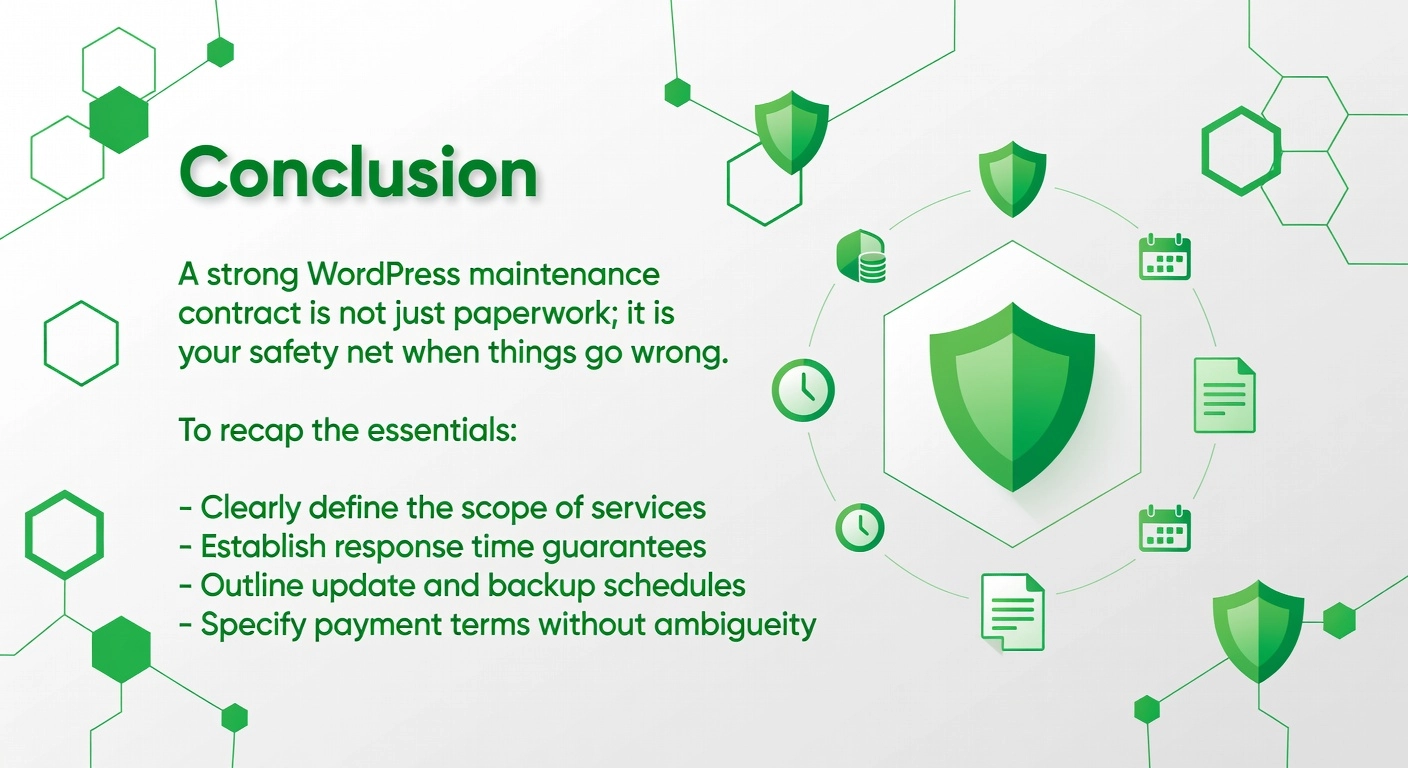
A strong WordPress maintenance contract is not just paperwork; it is your safety net when things go wrong. To recap the essentials: your contract must clearly define the scope of services, establish response time guarantees, outline update and backup schedules, and specify payment terms without ambiguity. These four pillars separate a professional agreement from a handshake deal that falls apart under pressure.
Do not wait for a 2 AM crisis to discover the gaps in your current arrangement. Review your existing contract today, or use these guidelines to build one from scratch before signing your next agreement.
The right contract protects your website, your business, and your working relationships. Whether you are the client or the developer, clarity upfront saves everyone time, money, and stress. Start with a solid foundation, and your WordPress site will be in good hands around the clock.