Most business leaders treat software documentation as something that happens after the real work is done. That framing is expensive. The role of software documentation in enterprise environments is not administrative tidying — it is the connective tissue that holds complex systems together across teams, time zones, and staff turnover. Better documentation reduces costly support interactions and improves product acquisition by over 56%. If your organisation is still treating docs as an afterthought, you are paying for that decision every single day.
Table of Contents
- Why software documentation is critical in enterprise environments
- Standards and frameworks shaping enterprise software documentation
- Tackling documentation drift: integrating docs into development workflows
- Strategic ownership and governance of enterprise documentation
- Tailoring documentation to diverse enterprise audiences
- Our perspective: documentation is not a deliverable, it is a discipline
- Build software that stays documented, not just delivered
- Frequently asked questions
Key Takeaways
| Point | Details |
|---|---|
| Documentation reduces costs | Effective documentation lowers maintenance and support expenses by improving clarity and reducing errors. |
| Integration avoids drift | Weaving documentation updates into development workflows prevents outdated information and maintains accuracy. |
| Ownership is essential | Assigning clear ownership to roles like business analysts ensures consistent and strategic documentation stewardship. |
| Tailor content by audience | Customising documentation for developers, users, and stakeholders enhances usability and reduces cognitive load. |
| Standards ensure compliance | Adhering to industry documentation standards helps enterprises meet regulatory requirements and maintain quality. |
Why software documentation is critical in enterprise environments
The importance of software documentation becomes undeniable when you look at where development time actually goes. Over 70% of the SDLC is consumed by maintenance rather than new feature development. That means the majority of your engineering spend is not building — it is understanding, fixing, and extending systems that already exist. Without clear documentation, every maintenance task starts with archaeology.
Think about what happens when a senior developer leaves. Their knowledge of why a particular architectural decision was made, what edge cases a module handles, and how a third-party integration behaves under load — all of that walks out the door with them. Good documentation captures that institutional knowledge before it disappears. The software maintenance impact on long-term costs is one of the most underestimated risks in enterprise software planning.

Documentation also directly improves software quality. When developers can read clear specifications before writing code, they make fewer assumptions. Fewer assumptions mean fewer bugs. It is that direct.
Key benefits of thorough enterprise documentation include:
- Faster onboarding for new team members, reducing the ramp-up period from months to weeks
- Reduced troubleshooting time because known issues and resolutions are recorded and searchable
- Better cross-team communication, particularly between technical and non-technical stakeholders
- Lower risk during system changes, since the impact of modifications can be assessed against documented dependencies
- Improved audit readiness, which matters enormously in regulated industries
Statistic: Enterprises with well-maintained documentation report significantly shorter incident resolution times, because engineers spend less time reverse-engineering system behaviour and more time solving the actual problem.
Standards and frameworks shaping enterprise software documentation
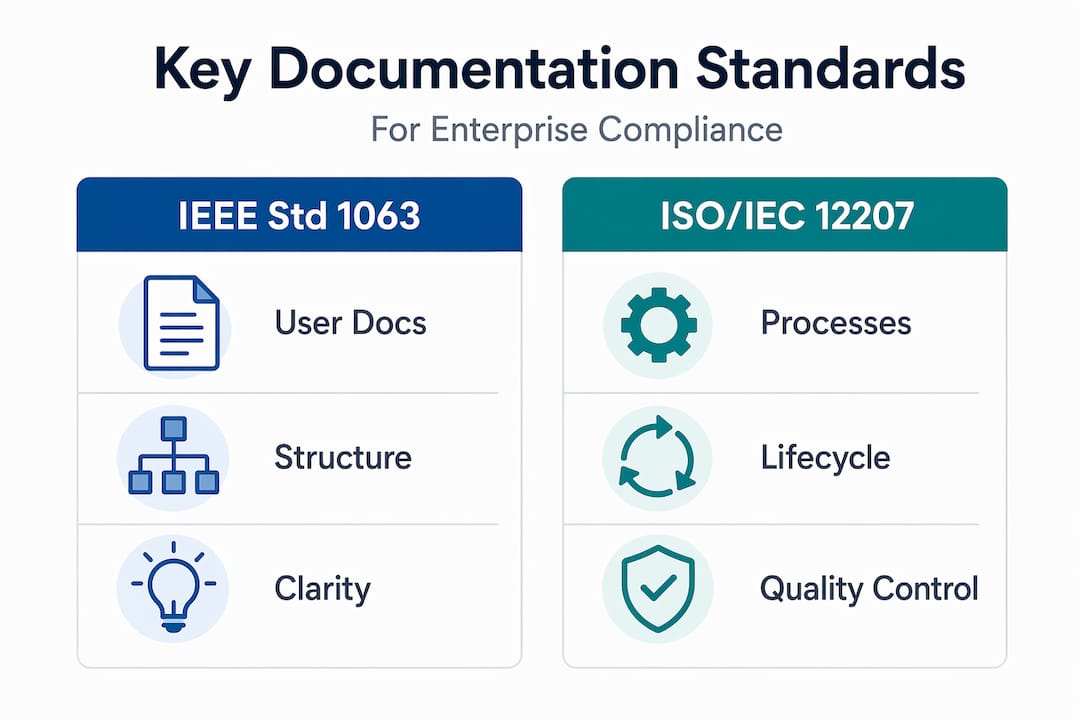
With the importance established, understanding the relevant documentation standards ensures quality and regulatory compliance. Two frameworks matter most at the enterprise level.
IEEE Std 1063 and ISO/IEC 12207 provide the structural backbone for enterprise documentation quality and processes. IEEE Std 1063 governs user documentation for software products, specifying what information must be included and how it should be organised. ISO/IEC 12207 takes a broader view, covering the entire software lifecycle and the documentation processes that support each phase.
For organisations in finance, healthcare, or government, these are not optional frameworks. Regulatory bodies expect documentation that is traceable, versioned, and auditable. Failing to meet that bar creates compliance exposure that can dwarf the cost of building the documentation in the first place.
| Standard | Primary focus | Relevant industries |
|---|---|---|
| IEEE Std 1063 | User documentation structure and content | All software-producing organisations |
| ISO/IEC 12207 | Software lifecycle processes and documentation | Enterprise, government, defence |
| ISO/IEC 26514 | Design and development of user documentation | Products with end-user interfaces |
| DITA (Darwin Information Typing Architecture) | Structured content authoring and reuse | Large-scale technical documentation teams |
Beyond compliance, these standards bring a discipline that most enterprises lack organically. When tailoring documentation content to fit your organisation, starting from a recognised framework saves significant design effort and prevents the most common structural mistakes.
Standards also support sustainable documentation maintenance. A consistent structure means any team member can locate, update, and extend documentation without needing to understand the idiosyncratic system the previous author invented. That consistency compounds over time into a genuinely useful knowledge base rather than a graveyard of outdated files.
Tackling documentation drift: integrating docs into development workflows
After standards, we address the practical challenge of keeping documentation up to date within development workflows. Documentation drift is what happens when code evolves but documentation does not. It is one of the most common and damaging problems in enterprise software, and it happens for a simple reason: updating docs is rarely tied to the same accountability structures as updating code.
A developer merges a pull request that changes an API endpoint. The code review passes. The tests pass. The deployment succeeds. But the API reference still describes the old behaviour. Six months later, a new integration partner builds against that reference and ships broken code. That is documentation drift in action, and the cost is real.
Docs-as-code pairs documentation updates with code changes to prevent drift and maintain accuracy. The methodology treats documentation files the same way you treat source code: stored in version control, reviewed in pull requests, and deployed through the same pipeline as the software itself. When a developer cannot merge code without updating the relevant docs, drift becomes structurally impossible.
Here is how to implement a docs-as-code approach in your enterprise:
- Store documentation in the same repository as the code it describes. This creates a natural link between code changes and documentation updates.
- Add documentation review to your pull request checklist. A reviewer should not approve a change that introduces undocumented behaviour.
- Use plain text formats like Markdown or reStructuredText. These work with standard version control tools and are readable without special software.
- Automate documentation builds. Tools that generate reference documentation directly from code comments (such as JSDoc or Sphinx) eliminate an entire category of drift.
- Set up automated link checking and content staleness alerts. These catch documentation that references deprecated features or broken links before users encounter them.
Pro Tip: If your team uses a ticketing system, create a documentation ticket alongside every feature ticket. Closing the feature ticket without closing the documentation ticket becomes a visible, trackable gap rather than an invisible one.
Continuous documentation takes this further by automating the detection of outdated content at scale. Enterprise documentation tools for teams can scan codebases, flag discrepancies between code and docs, and even suggest updates. This is particularly valuable for large platforms where manual review of every change is not feasible.
Strategic ownership and governance of enterprise documentation
Understanding workflow integration leads naturally to the critical topic of ownership and governance. The single most common reason enterprise documentation fails is not a tooling problem or a time problem. It is an ownership problem.
Lack of clear ownership leads to fragmented, inconsistent documentation and project failures. When everyone is responsible for documentation, no one is. Different teams develop different conventions, different levels of detail, and different update cadences. The result is a documentation ecosystem that actively misleads the people trying to use it.
Business analysts are particularly well-suited to the stewardship role. They sit at the intersection of technical and business knowledge, which means they can translate between what a system does and what a business needs it to do. That translation is exactly what good documentation requires.
Effective governance structures for enterprise documentation typically include:
- A designated documentation owner for each system or service, with explicit accountability
- A documentation review cycle tied to release schedules, not just ad hoc updates
- Defined documentation standards that all contributors follow, reducing inconsistency
- Escalation paths for documentation disputes or gaps identified during audits
- Metrics that track documentation coverage, freshness, and usage
The clear ownership importance extends beyond just keeping docs current. It also determines who gets consulted when a system change is planned, who signs off on documentation before a major release, and who is responsible when a documentation gap causes an incident.
Pro Tip: Treat documentation debt the same way you treat technical debt. Track it, prioritise it, and allocate sprint capacity to address it. Organisations that do this consistently find their documentation quality improves steadily rather than degrading between major projects.
Embedding documentation updates into the delivery lifecycle, rather than treating them as a post-release task, is what separates enterprises with genuinely useful documentation from those with documentation that exists only on paper.
Tailoring documentation to diverse enterprise audiences
With governance in place, tailoring content ensures documentation truly serves its varied enterprise users. One of the most persistent mistakes in enterprise documentation is writing a single document and expecting it to serve everyone. Developers, end users, and executive stakeholders need fundamentally different information, presented in fundamentally different ways.
Audience-specific documentation greatly increases its effectiveness and reduces cognitive overload. A developer reading an API reference does not need a business context paragraph explaining why the API exists. A non-technical stakeholder reading a system overview does not need a table of HTTP status codes. Mixing these audiences into a single document serves neither well.
| Audience | Documentation type | Key content needs |
|---|---|---|
| Developers | Technical specifications, API references, architecture diagrams | Precise behaviour, edge cases, code examples |
| End users | Tutorials, how-to guides, FAQs | Step-by-step instructions, plain language, screenshots |
| System administrators | Deployment guides, configuration references | Environment setup, troubleshooting, security settings |
| Business stakeholders | System overviews, release notes, compliance summaries | Business impact, feature changes, risk summaries |
The three primary documentation categories in enterprise software are:
- Product documentation: describes what the software does and how to use it, aimed at end users and stakeholders
- Process documentation: covers how the software is built, tested, and deployed, aimed at development and operations teams
- System documentation: details the technical architecture, data models, and integration points, aimed at developers and architects
Effective enterprise software documentation strategies recognise that audience-focused documentation is not a luxury. It is what determines whether documentation gets read and used, or ignored. When developers cannot find the technical detail they need because it is buried in a user guide written for non-technical staff, they stop consulting the documentation altogether. That is when tribal knowledge takes over, and tribal knowledge does not survive staff turnover.
Our perspective: documentation is not a deliverable, it is a discipline
Here is the uncomfortable truth that most enterprise software conversations avoid: documentation fails not because teams lack the tools or the time, but because organisations treat it as a deliverable rather than a discipline. A deliverable has a completion date. A discipline has no end.
We have seen this pattern repeatedly in enterprise engagements. A project wraps up, the documentation is written, the box is ticked, and the docs are never touched again. Two years later, the system has evolved significantly, the original authors have moved on, and the documentation describes a system that no longer exists. The organisation then faces a choice between expensive re-documentation and operating with documentation that actively misleads.
The teams that get this right do not have better tools. They have a different relationship with documentation. They treat every code change as a documentation event. They budget for documentation maintenance the same way they budget for infrastructure. They measure documentation quality as a system health metric, not a project milestone.
There is also a subtler point worth making. The act of writing documentation forces clarity of thought. When a developer cannot explain a system component in plain language, that is often a signal that the component itself is poorly designed. Documentation is not just a record of what was built — it is a quality gate for how it was built. Organisations that embed documentation into their engineering culture tend to build cleaner systems, not just better-documented ones.
Build software that stays documented, not just delivered
If the ideas in this article resonate, it is worth asking whether your current software partner treats documentation as a first-class concern or a finishing task.
At Pixeldev, we build custom web platforms with documentation baked into the delivery process, not bolted on at the end. Every system we build is designed to be understood, maintained, and extended by your team long after the initial build is complete. Our journal covers the practical side of building software that lasts, including how we approach documentation as part of long-term system health. If you are building something that needs to work reliably for years, not just launch day, we would be glad to talk.
Frequently asked questions
What is the main benefit of software documentation for enterprises?
It reduces maintenance costs, accelerates onboarding, and improves system reliability by providing a clear knowledge base for teams. Documentation reduces onboarding efforts and helps maintain software effectively across staff changes and system evolution.
How can enterprises prevent documentation from becoming outdated?
By integrating documentation updates into the development workflow using methods like docs-as-code and automated continuous documentation tools. Docs-as-code integrates documentation updates with code changes to structurally prevent drift.
Who should own enterprise software documentation?
Clear ownership is critical; business analysts or dedicated technical writers typically lead this stewardship to ensure consistency and alignment with business goals. Business analysts are ideally positioned to own and steward documentation in enterprise environments.
What standards guide enterprise software documentation?
Standards like IEEE Std 1063 and ISO/IEC 12207 provide frameworks for structured documentation ensuring compliance, especially in regulated industries. IEEE Std 1063 and ISO/IEC 12207 govern enterprise documentation quality and processes across the software lifecycle.