Poorly defined requirements are the single most expensive mistake you can make before writing a line of code. When you need to define custom software requirements at enterprise scale, the stakes are not just high — they are organisational. Vague specifications create rework, missed deadlines, and systems that cannot grow with your business. This guide walks you through exactly how to prepare, define, and verify requirements that hold up under real operational pressure, so your investment produces software that lasts years rather than months.
Table of Contents
- Understanding the challenges of defining enterprise-scale software requirements
- Preparing to gather requirements effectively
- Defining clear, testable, and actionable requirements
- Addressing integration and scalability in enterprise software requirements
- Verifying and prioritising requirements with business stakeholder input
- Rethinking enterprise software requirements: embracing a hybrid build-buy approach
- Discover Pixeldev’s expertise in crafting scalable enterprise software
- Frequently asked questions
Key Takeaways
| Point | Details |
|---|---|
| Time investment | Defining enterprise software requirements can take 6 to 24 months and must not be rushed. |
| Collaborative process | Involve both IT and business stakeholders to prioritise and validate requirements effectively. |
| Testable requirements | Write clear, measurable, and verifiable requirements to reduce ambiguity and risk. |
| Integration focus | Treat integration as a core requirement to avoid costly overruns and ensure maintainability. |
| Strategic approach | Consider hybrid build-buy models focusing custom development on differentiation layers. |
Understanding the challenges of defining enterprise-scale software requirements
To tackle the complexity, you must first understand why requirement definition is particularly challenging at enterprise scale. The instinct of most leadership teams is to treat requirements gathering as a brief discovery phase before the “real work” begins. That instinct is wrong, and it costs organisations dearly.
Requirements gathering for enterprise systems like ERP platforms can take 6 to 24 months and account for 50% to 75% of total project work. That is not a bug in the process. That is the process working correctly. The problem arises when executives compress that timeline and expect engineers to fill in the gaps with assumptions.
There are three structural reasons why enterprise requirements are so difficult to get right:
- Organisational complexity. Large organisations have dozens of departments, each with different workflows, priorities, and definitions of success. A procurement team and a finance team may both interact with the same module but have entirely different expectations of how it should behave.
- Tacit knowledge gaps. Users know what they do, but they rarely know how to articulate what they need. They describe current workarounds rather than underlying problems, which leads to requirements that replicate broken processes in expensive new software.
- Evolving business context. Enterprise projects run for years. By the time a system launches, the business conditions that shaped the original requirements may have shifted. Requirements must be written with enough clarity to survive that drift.
“The biggest mistake organisations make is assuming that users can simply tell you what they need. In reality, requirements must be discovered through observation, workshops, prototyping, and structured analysis — not just interviews.”
Incomplete requirements are the leading cause of project delays and failures in large-scale custom software development. The solution is not to gather more requirements faster. It is to gather them more rigorously, using multiple complementary techniques.
Preparing to gather requirements effectively
With awareness of the challenges, the next step is preparing an organised, collaborative environment for requirements gathering. Preparation is not glamorous, but it determines whether your requirements process produces clarity or noise.

Start with stakeholder mapping. Every person who will use, maintain, approve, or be affected by the software needs a seat at the table — at least briefly. This includes IT architects, department heads, end users, compliance officers, and executive sponsors. Each group sees a different slice of the problem.
Key preparation steps before you begin formal requirements gathering:
- Define scope boundaries explicitly. Document what the software will not do as clearly as what it will. Scope creep begins the moment a boundary is left ambiguous.
- Establish a requirement rating process. Not all requirements carry equal weight. You need a structured method for distinguishing must-have functionality from desirable extras before the first workshop runs.
- Assign a requirements owner. Someone must be accountable for the completeness and consistency of the requirements document. Without ownership, requirements drift and contradict each other.
- Set up a shared requirements repository. Whether you use a dedicated tool or a structured document, all requirements must live in one place with version control.
- Agree on a documentation standard. Decide upfront how requirements will be written, reviewed, and approved. Inconsistent formats create confusion during development and testing.
IT should draft technical requirements, but business teams must separately rate them for importance to ensure alignment with operational needs. This separation is deliberate. When IT and business teams rate requirements together in the same room, social dynamics often skew the results. Business leaders defer to technical authority on feasibility; engineers defer to seniority on priority. Separating the rating process surfaces genuine disagreement rather than masking it.
Pro Tip: Run a “scope boundary” workshop before any requirements sessions. Ask stakeholders to vote on whether specific scenarios are in or out of scope. The disagreements that surface will save you weeks of rework later.
Defining service level agreements and availability benchmarks at this stage, rather than retrofitting them later, prevents the common situation where performance expectations exist only in someone’s head until go-live.
Defining clear, testable, and actionable requirements
Having prepared your team and scope, you now focus on crafting requirements that are clear and testable. A requirement that cannot be tested is not a requirement. It is a wish.
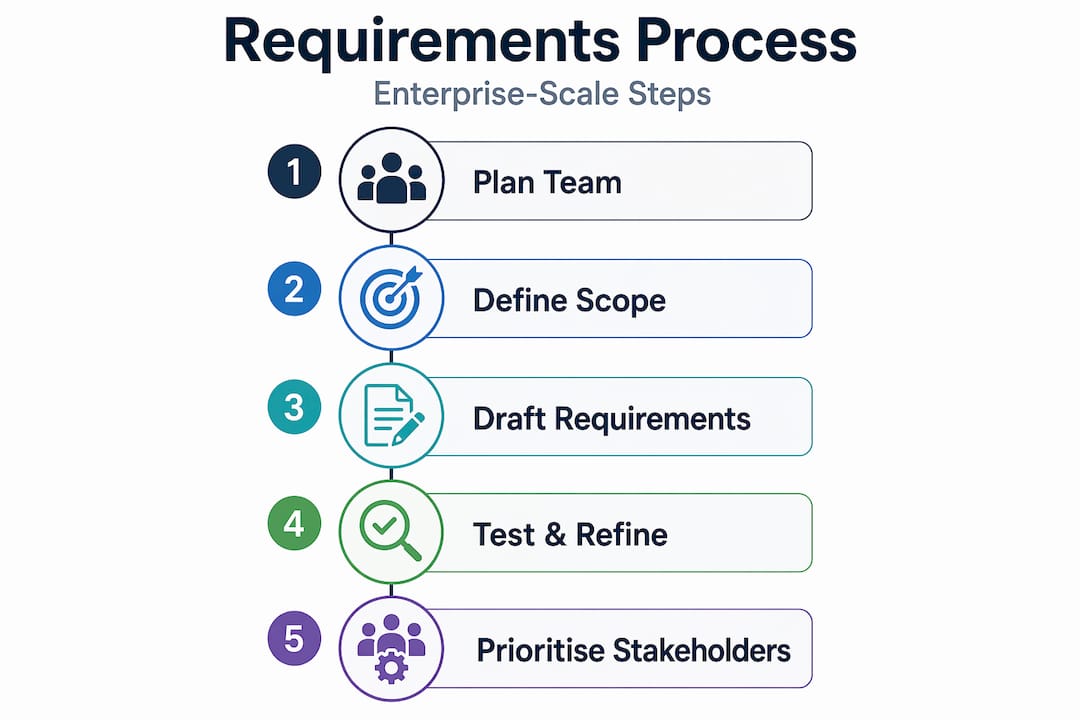
The most important discipline in writing enterprise application specifications is separating functional requirements from non-functional ones. Functional requirements describe what the system does. Non-functional requirements describe how well it does it.
Functional requirement example: “The system shall allow a finance manager to generate a monthly expenditure report filtered by cost centre.”
Non-functional requirement example: “The report generation function shall return results within three seconds for datasets up to 500,000 records.”
Both are necessary. Most teams write the first type adequately and neglect the second entirely until performance problems appear in production.
Testable requirements must be verifiable through specific test cases. A well-written example: “new users complete onboarding at least 80% of the time without assistance.” That requirement can be tested. “The onboarding experience should be intuitive” cannot.
Use this framework when writing each requirement:
| Requirement element | What to specify | Poor example | Strong example |
|---|---|---|---|
| Action | What the system does | “Handle user login” | “Authenticate users via SSO within 2 seconds” |
| Actor | Who triggers it | “Users can export” | “Administrators can export audit logs as CSV” |
| Condition | When it applies | “Show error messages” | “Display validation error if field is empty on submit” |
| Acceptance criteria | How success is measured | “Works correctly” | “Passes 100% of defined test cases in staging” |
| Error handling | What happens on failure | “Handle errors gracefully” | “Return HTTP 503 with retry-after header on service timeout” |
Non-functional requirements that must be explicit in every enterprise software requirement analysis include performance thresholds, concurrent user capacity, security controls (authentication, authorisation, encryption standards), data retention policies, and accessibility compliance levels.
Pro Tip: Write requirements in layers. A one-page business-level summary for executives, a detailed functional specification for product owners, and a technical specification for engineers. All three documents should be traceable to each other so that changes at one level propagate correctly.
Addressing integration and scalability in enterprise software requirements
Beyond basic functionality, addressing integration and scalability early is critical for enterprise success. These two areas are where large-scale software requirements most frequently collapse under real-world conditions.
Integration complexity is the largest source of project cost overruns. Yet integration is routinely treated as a detail to sort out during development rather than a first-class requirement. This is backwards.
Before writing a single integration requirement, catalogue every external system your software will touch:
- List all data sources. Include databases, third-party APIs, legacy systems, file feeds, and manual imports. Do not assume anything is out of scope until confirmed.
- Define the data contract for each integration. Specify the data format (JSON, XML, CSV), the transport protocol (REST, SOAP, SFTP), authentication method, and expected response times.
- Document error handling for each connection. What happens when an external system is unavailable? Does the software queue, fail gracefully, alert an operator, or abort the transaction?
- Specify data transformation rules. If your system receives data in one format and stores it in another, that transformation logic must be documented as a requirement, not left to developer interpretation.
- Set scalability targets explicitly. State the number of concurrent users at launch, the expected growth rate over three years, and the data volume the system must handle at peak load.
| Integration approach | Best suited for | Risk level | Maintenance burden |
|---|---|---|---|
| Direct API calls | Real-time, low-volume data | Medium | High if API changes |
| Message queuing | Async, high-volume transactions | Low | Medium |
| File-based batch transfer | Legacy systems, scheduled updates | High | Low |
| Event-driven architecture | Distributed, modular systems | Medium | Medium |
Modular architecture is not just a technical preference. It is a requirements decision. When you specify that each integration should be isolated behind a defined interface, you are protecting the rest of the system from cascading failures when one external service changes or goes down.
Scalability targets belong in your service level agreements from day one, not as an afterthought once the system is under load.
Verifying and prioritising requirements with business stakeholder input
Once requirements are drafted, collaborative verification and prioritisation ensure they meet business needs and practical feasibility. A requirements document that has not been challenged by business stakeholders is a liability, not an asset.
Business teams must rate requirements for importance to align software with operational needs, preventing failures that come from isolated IT drafting. The rating process should be structured, not conversational.
A practical approach to structured verification:
- Use a three-tier priority scale. Must-have (the system fails without it), should-have (significant operational impact if missing), and could-have (desirable but deferrable). Avoid five-tier scales. They create false precision and endless debate.
- Document the requester and the business justification for each item. “The accounts payable team needs this because month-end close takes three extra days without it” is accountable. “Someone mentioned this in a meeting” is not.
- Run independent rating sessions by department. Aggregate the results before sharing them. This prevents the loudest voice in the room from distorting the priority list.
- Set a hard ceiling on must-have requirements. If everything is critical, nothing is. Enforce a rule that no more than 40% of requirements can be classified as must-have in the first pass.
- Schedule iterative review cycles. A single sign-off meeting is not verification. Plan at least two rounds of review with a gap between them. Stakeholders often identify gaps or contradictions only after sleeping on the first draft.
Pro Tip: Create a “requirement traceability matrix” that maps every requirement back to a specific business goal. During prioritisation reviews, requirements that cannot be traced to a measurable business outcome are the first candidates for deferral.
The goal of defining requirements for large organisations is not to produce a perfect document on the first attempt. It is to create a living specification that evolves through structured dialogue rather than ad hoc change requests.
Rethinking enterprise software requirements: embracing a hybrid build-buy approach
Here is an uncomfortable truth that most requirements guides skip over: not everything your enterprise needs should be custom built. The decision about what to build versus what to buy is itself a requirements decision, and getting it wrong is expensive in both directions.
Most enterprise companies succeed with a hybrid model: buy commodity layers and build the unique differentiation layer, with engineering rigour on integration. This framing changes how you approach your requirements process entirely.
When you begin defining requirements, you should be asking a parallel question for every functional area: is this a commodity function or a differentiating one? HR administration, standard financial reporting, and email notifications are commodity functions. The specific workflow that makes your supply chain faster than your competitors, or the data model that reflects your unique service structure, is a differentiating function. Build the second type. Buy the first.
The trap many enterprises fall into is building commodity functions from scratch because they want “full control,” then discovering that maintaining a bespoke leave management system consumes engineering capacity that should be focused on genuine competitive advantage. The integration layer between your custom core and your off-the-shelf components is where the real engineering challenge lives. That integration must be treated as a first-class requirement, not a footnote.
A modular monolith architecture, where the system is a single deployable unit internally divided into well-defined modules, often serves enterprise needs better than a microservices architecture for teams under 50 engineers. It reduces operational complexity while still allowing individual modules to be replaced or upgraded independently. This is a requirements and architecture decision that should be made before detailed specifications are written, not after.
The organisations that struggle most with custom software requirements for large organisations are those that treat requirements gathering as a one-time event rather than an ongoing discipline. Requirements should be revisited at every major milestone, with a formal process for assessing whether business conditions have shifted enough to warrant changes.
Discover Pixeldev’s expertise in crafting scalable enterprise software
Defining requirements at enterprise scale is genuinely difficult work. Getting it right requires a partner who has navigated the same integration challenges, stakeholder conflicts, and architectural decisions you are facing now.
Pixeldev specialises in custom software development for organisations that need durable, maintainable systems built around their specific operational reality. From the first requirements workshop through to ongoing maintenance and hotfixes, the team brings senior-level rigour to every stage of the project lifecycle. Their enterprise software services cover requirement analysis, integration architecture, and long-term system reliability. If you want to see what that looks like in practice, the OnCloudWine case study shows how a complex, custom platform was built to last. Reach out to Pixeldev before your requirements phase begins, not after.
Frequently asked questions
What makes a software requirement testable at enterprise scale?
A testable requirement clearly defines how success is measured through specific, verifiable criteria such as performance thresholds or user success rates. For example, a well-formed requirement states that “new users complete onboarding at least 80% of the time without assistance” rather than describing a vague desired experience.
Why is stakeholder involvement critical in defining enterprise software requirements?
Involving business stakeholders ensures requirements reflect operational priorities, preventing IT-driven solutions that miss actual business needs. Business teams must rate requirements separately from IT to surface genuine priority conflicts before development begins.
How long does requirements gathering typically take for enterprise systems?
Identifying requirements for major enterprise systems can take from six months up to two years due to organisational complexity and the thoroughness required. Requirements gathering for ERP systems can constitute 50% to 75% of total project work.
What are common causes of cost overruns in custom enterprise software projects?
Integration complexity, scope creep, and data migration challenges are the most frequent causes of budget overruns in enterprise software builds. Integration complexity is consistently identified as the largest single source of cost overruns in large-scale custom software projects.