Startup software cost explained for founders in 2026
Getting a clear picture of startup software cost explained properly is something most founders wish they’d had before signing their first contract or spinning up their first server. The numbers vary wildly. An indie hacker might spend under $5,000 launching an MVP, while a seed-funded team can burn through $500,000 in year one. Neither figure is wrong. They reflect completely different approaches, team structures, and scale expectations. What matters is understanding which cost drivers apply to your situation, so you can budget for the full picture rather than just the headline development fee.
Table of Contents
- Key takeaways
- Startup software cost explained: the core components
- Infrastructure costs as your startup scales
- Total cost of ownership and ongoing maintenance
- Evaluating software purchases with cost-benefit thinking
- My honest take on budgeting software as a startup
- How Pixeldev helps you build within budget
- FAQ
Key takeaways
| Point | Details |
|---|---|
| MVP costs vary by model | Indie launches can start under $5,000, while seed-funded builds often exceed $150,000 in year one. |
| Infrastructure should scale with revenue | Budget roughly 5–15% of monthly revenue on hosting and infrastructure once you reach paying users. |
| Maintenance is a recurring cost | Plan for 15–25% of your original build cost each year to keep software functional and secure. |
| Hidden costs add up fast | Compliance, training, migration, and tooling subscriptions can double your true ownership cost. |
| Sticker price misleads buyers | Total cost of ownership includes onboarding, lock-in risk, and opportunity cost beyond the subscription fee. |
Startup software cost explained: the core components
The industry term for what founders are really budgeting for is total cost of ownership (TCO). That covers every dollar from first commit to ongoing operations. Most articles stop at development. This one does not.
MVP development costs sit in a wide range depending on how you build. Indie hackers and solo founders building with off-the-shelf tools typically spend $1,000 to $5,000. Bootstrapped founders hiring freelancers or a small agency land between $30,000 and $80,000 for their first year all-in. Seed-funded teams with salaried engineers, a product manager, and a designer can push $150,000 to $500,000, with salaries accounting for the bulk of that spend.
Beyond development, founders often underestimate the cost of getting their product live and compliant. Here is a breakdown of the main cost categories you should account for when budgeting for startup software:
| Category | Indie/bootstrapped | Seed-funded |
|---|---|---|
| MVP development | $1,000–$30,000 | $80,000–$250,000 |
| Infrastructure (year 1) | $0–$2,000 | $5,000–$30,000 |
| Salaries (year 1) | $0–$60,000 | $120,000–$350,000 |
| Compliance (e.g. SOC 2) | Deferred | $20,000–$35,000 |
| Marketing and admin tools | $500–$5,000 | $10,000–$50,000 |
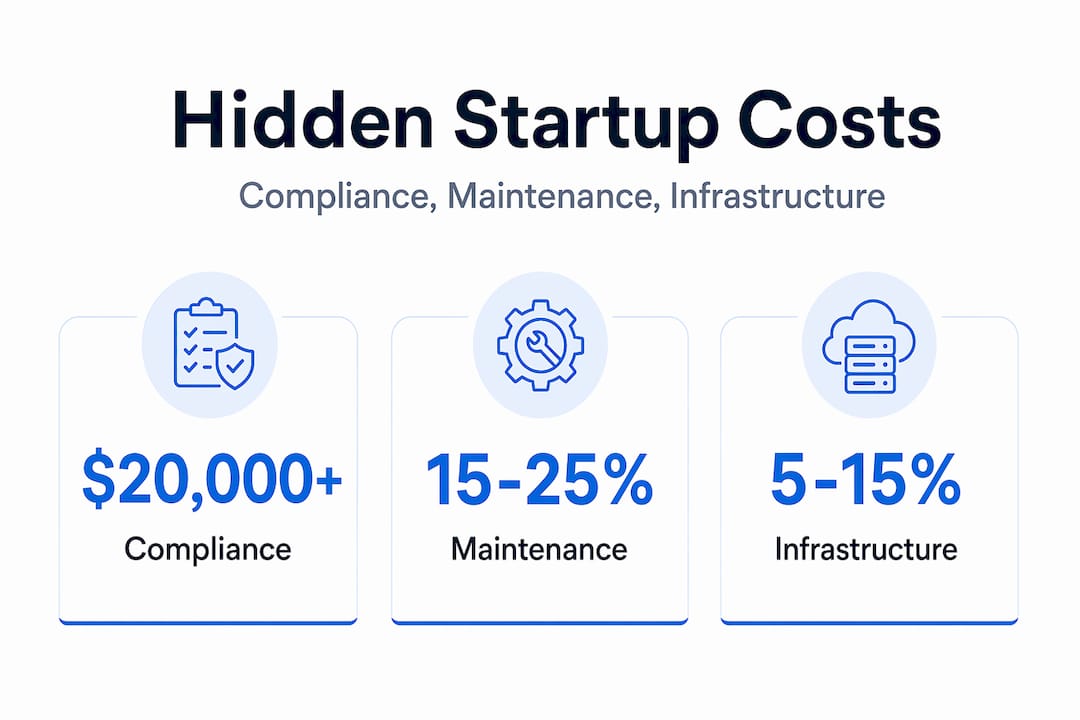
Compliance costs catch many founders off guard. A SOC 2 Type 2 certification typically runs $20,000 to $35,000 in year one for a small SaaS, once you factor in audit fees, readiness assessment, security tooling, and internal staff time. That is a line item that disappears from most early budgets and reappears as a nasty surprise when an enterprise customer asks for your audit report.
Pro Tip: If you are not yet selling to enterprise clients, you can defer SOC 2 spend. But do begin building compliant habits in your code and processes from day one. Retrofitting compliance is significantly more expensive than building it in early.
Infrastructure costs as your startup scales
Infrastructure is one of the most misunderstood budget lines in software expenses for new businesses. It feels small at the start, which is exactly when founders either ignore it or, ironically, overspend on tools they do not need yet.

A practical benchmark: infrastructure should sit around 5–15% of monthly revenue. Before you have any paying users, that number is close to zero. At $1,000 MRR, expect to spend roughly $50 to $150 per month on hosting. At $10,000 MRR, that grows to $500 to $1,500. It scales with you rather than hitting you upfront.
What does that money actually cover? At early stages, a typical monthly stack might include:
- Hosting and compute: $20–$80 (free tiers from platforms like Railway or Fly.io)
- Database: $0–$25 (managed Postgres on a free or starter plan)
- Caching layer: $0–$20 (Redis on a shared instance)
- Email delivery: $0–$15 (SendGrid or Postmark free tiers)
- Monitoring: $0 (skip paid monitoring until you have real traffic to monitor)
That last point matters. Premature monitoring spend before your product has meaningful usage is one of the most common early-stage infrastructure mistakes. Founders buy Datadog seats or set up expensive observability stacks before they have enough users to justify the signal-to-noise ratio.
Infrastructure overspending typically comes from idle services left running, per-seat monitoring fees multiplying across team members, or self-managed cloud setups that hide the true labour cost of maintenance. If you are spending over 20% of revenue on infrastructure, something is likely misconfigured or unused.
Pro Tip: A solo founder running multiple production AI SaaS products can keep fixed hosting costs as low as $5 per month using free tiers strategically. Variable AI API spend will add $200 to $250 per month on top for production use, but the base infrastructure cost does not have to be a burden early on.
Total cost of ownership and ongoing maintenance
Understanding startup software ownership explained properly means accepting one uncomfortable truth: the build cost is rarely the biggest number over a three-year horizon. Ongoing maintenance is.
The standard maintenance budgeting rule is to set aside 15 to 25 percent of your original development cost each year. If your MVP cost $60,000 to build, expect to spend $9,000 to $15,000 annually just to keep it running, secure, and compliant. That covers four distinct types of work:
- Corrective maintenance: fixing bugs and resolving incidents as they occur
- Adaptive maintenance: updating the software as third-party dependencies, APIs, or operating environments change
- Perfective maintenance: adding features or improving performance based on user feedback
- Preventive maintenance: refactoring code and reducing technical debt before it becomes a crisis
The compliance side of ownership is where budgets quietly blow out. Engineering time for SOC 2 evidence collection alone runs 40 to 150 hours per audit cycle. The actual auditor fees are often less than half of your true first-year compliance spend. Security tooling, internal policy documentation, and remediation work fill the rest.
There is also a category of costs that get overlooked entirely when evaluating software tools or platforms you plan to purchase: onboarding, data migration, and training. A $500 per month SaaS subscription might require 40 hours of staff time to implement, two weeks of data migration work, and a training programme for your team. Those are real costs that belong in your budget.
Pro Tip: Use Xero’s approach of combining one-time costs with 3 to 6 months of recurring expenses to stress-test your cash runway. Development fees are not a one-off. Think in terms of ongoing monthly commitments from day one.
Evaluating software purchases with cost-benefit thinking
When you are weighing up whether to buy a software tool, affordability is not just about the monthly fee. The real total cost includes every dollar and hour the tool will consume across its full lifecycle in your business. For a startup that is capital-constrained, the difference between a tool that saves time and one that costs time can be the difference between hitting or missing a runway milestone.
Here is how to structure a cost-benefit analysis for any significant software purchase:
- Total cost line: subscription fees plus implementation, migration, training, support overhead, and contract lock-in risk
- Time savings: hours saved per week across your team, translated into dollar value at average hourly cost
- Headcount deferral: can this tool delay or remove the need to hire a role? At $80,000 per salary, deferring one hire for six months saves $40,000
- Compliance and risk reduction: does the tool reduce audit exposure, data risk, or regulatory liability?
- Decision speed: does the tool give your team better data faster, compressing your feedback loops?
Once you have those numbers, model three scenarios: conservative, expected, and aggressive. This tells you the floor and ceiling of the tool’s value before you commit. A startup software pricing guide built around scenario modelling protects you from both overspending on tools you barely use and underspending on tools that would have accelerated growth.
The biggest mistake is treating a software subscription as a fixed cost and a hire as a variable cost. In reality, the right software tool IS headcount. Budget it that way.
Pro Tip: Before upgrading to an enterprise plan, check whether the feature you actually need is available via a cheaper add-on or a competitor with a lower per-seat fee. Enterprise pricing exists to extract maximum value from buyers who have not done their homework.
My honest take on budgeting software as a startup
I have sat across the table from founders who budgeted $40,000 for their software build and thought they were done. They were not done. They were at the start.
What I have seen consistently is that the founders who scale well treat software cost as an ongoing operational commitment rather than a project that closes. They accept that maintenance is a line item in every budget cycle, not a surprise. They delay compliance spend deliberately but not indefinitely. And they treat every tool subscription as a hiring decision.
The part that trips people up most is infrastructure. In my experience, founders either spend nothing and then scramble when a traffic spike kills their server, or they provision enterprise-grade monitoring before they have ten users. Neither extreme serves them. The lean infrastructure discipline of starting on free tiers and scaling with revenue is not just about saving money. It is about staying focused on product-market fit before optimising for scale.
I also think the compliance conversation happens too late. Founders treat SOC 2 as something that happens when an enterprise deal demands it. That reactive timing costs two to three times more than starting the groundwork at the right stage of growth.
The most grounded advice I can give you: do not hire until revenue supports the hire, do not scale infrastructure ahead of users, and do not defer compliance tooling until it becomes an emergency. Build those habits early and the cost of ownership becomes predictable rather than punishing.
— Liam
How Pixeldev helps you build within budget
Knowing your numbers is only half the equation. You still need to build something durable.
Pixeldev works with startup founders and project managers who are serious about building software that does not need to be replaced in 18 months. The team specialises in custom web platforms designed for longevity, with architecture choices that keep infrastructure costs low during early stages and scale cleanly as revenue grows. From initial design through to maintenance and hotfixes, every engagement is scoped with total cost of ownership in mind. If you are weighing up your web application options or want a clear-eyed view of what a bespoke build would actually cost your business, explore Pixeldev’s approach to software that is built to last. You can also explore their small business software solutions to understand which platform model fits your stage and budget.
FAQ
How much does software cost for a startup?
MVP development costs range from $1,000 to $5,000 for indie founders up to $150,000 or more for seed-funded teams, with first-year all-in costs spanning $30,000 to $500,000 depending on team size and approach.
What is a realistic annual maintenance budget for startup software?
Plan for 15 to 25 percent of your original development cost each year. A $60,000 build typically requires $9,000 to $15,000 annually in maintenance, updates, and security work.
When should a startup budget for SOC 2 compliance?
SOC 2 Type 2 certification typically costs $20,000 to $35,000 in year one. Budget for it when you begin selling to enterprise clients or when a significant deal depends on it, but start building compliant practices from day one.
What percentage of revenue should infrastructure cost?
Infrastructure for a SaaS startup should sit at roughly 5 to 15 percent of monthly recurring revenue. At $1,000 MRR, that means $50 to $150 per month in hosting and related services.
What hidden costs should startups include in software budgets?
Beyond development and hosting, include onboarding, data migration, staff training, tool subscriptions, compliance audits, and the opportunity cost of engineering time spent on maintenance rather than new features.