Maintainable web apps: Australian standards guide
Australian tech teams waste enormous time and money rebuilding web applications that should have been built right the first time. The pressure to ship fast often pushes maintainability down the priority list, and the consequences compound: security incidents, accessibility complaints, and systems that collapse under their own technical debt within two years. To build a maintainable web application to Australian standards, you need more than good intentions. You need a structured approach covering compliance, architecture, development practice, and ongoing verification. This guide covers all of it.
Table of Contents
- Key takeaways
- Build maintainable web applications to Australian standards
- Planning and architecture for long-term maintainability
- Development practices that embed maintainability
- Verification, monitoring, and ongoing maintenance
- My perspective on maintainability as a mindset
- How Pixeldev builds lasting Australian web applications
- FAQ
Key takeaways
| Point | Details |
|---|---|
| Compliance is non-negotiable | WCAG 2.2 Level AA, Privacy Act 1988, and the Cyber Security Act 2024 set the baseline for all Australian web applications. |
| Architecture determines longevity | Investing in discovery and modular design upfront prevents costly refactoring within 18 to 24 months. |
| Accessibility is full-stack work | APIs and data structures must support non-visual interaction, not just the frontend UI layer. |
| Local hosting matters | Australian-hosted infrastructure improves compliance, latency, and data sovereignty under current legislation. |
| Maintenance is a continuous cycle | Automated audits, dependency monitoring, and scheduled refactoring sustain compliance and performance post-launch. |
Build maintainable web applications to Australian standards
When most teams talk about web application best practices, they mean things like clean code, version control, and automated testing. Those matter. But in Australia, maintainable software development also means navigating a specific and evolving regulatory environment that shapes what your application must do from day one.
The core compliance layer every Australian web application sits within includes:
- WCAG 2.2 Level AA accessibility as the minimum accessibility standard mandated by the Australian Human Rights Commission. This standard added 9 new success criteria and removed 1, and it is now the benchmark used in Australian courts and government procurement.
- Privacy Act 1988 and the Australian Privacy Principles, which govern how personal data is collected, stored, and processed. Failure here carries serious legal exposure.
- Sector-specific obligations: financial services applications require APRA and ASIC compliance; healthcare systems follow the My Health Records Act; payment platforms must meet PCI DSS requirements.
- Cyber Security Act 2024, which enforces stricter security and reporting obligations including mandatory ransomware reporting and new powers for the Cyber Incident Review Board.
To help you see these obligations at a glance, here is how key Australian standards map to development concerns:
| Standard | Who it applies to | Primary development concern |
|---|---|---|
| WCAG 2.2 Level AA | All public-facing web apps | Accessibility across UI, APIs, and data |
| Privacy Act 1988 | Any entity handling personal data | Data handling, storage, and consent flows |
| Cyber Security Act 2024 | Critical infrastructure and many tech firms | Incident reporting and security architecture |
| APRA/ASIC | Financial services | Data governance and audit trails |
| My Health Records Act | Healthcare platforms | Patient data security and access controls |
Understanding this landscape is not optional background reading. It directly shapes every architectural and development decision that follows.
Planning and architecture for long-term maintainability
The most expensive mistake Australian teams make is treating compliance and maintainability as problems to solve after the application is built. Early architecture investment consistently pays off, reducing the risk of costly refactoring and system failure within 18 to 24 months of launch.
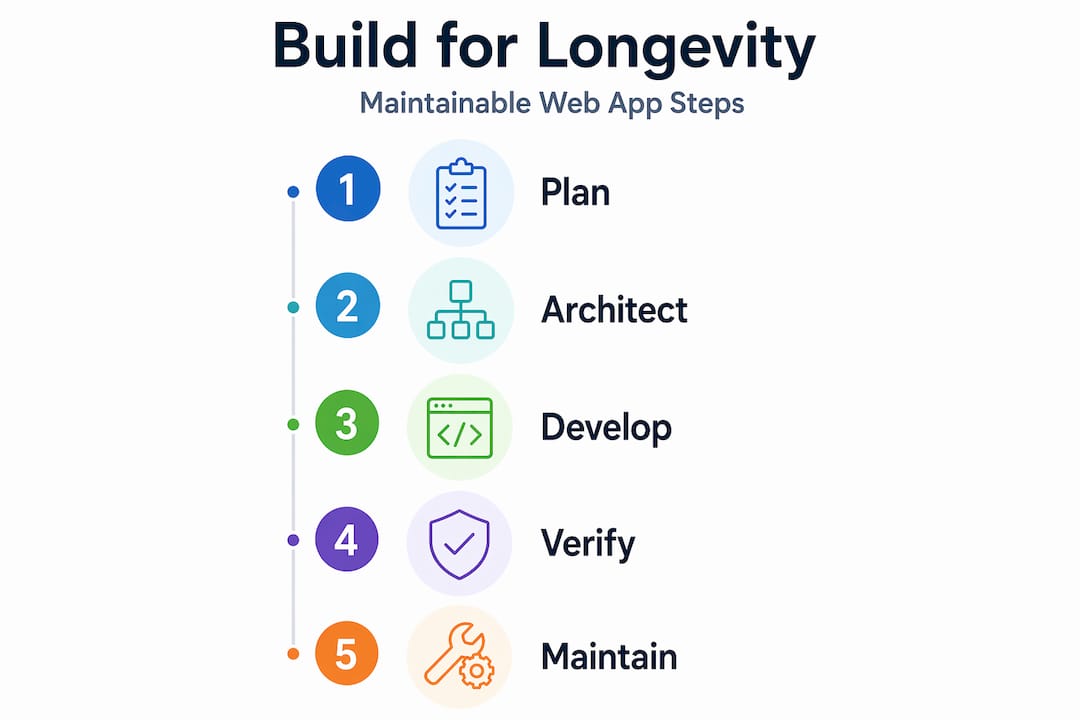
A well-planned project follows a logical preparation sequence:
-
Run a comprehensive discovery phase. Map your business goals, compliance obligations, user needs, and integration requirements before writing a single line of code. This is where you identify which Australian standards apply and how they constrain your architecture choices.
-
Design for modularity from the start. A modular architecture lets you update, replace, or scale individual components without destabilising the whole system. This is what building scalable applications actually looks like in practice: not one monolithic codebase, but discrete, well-defined services and modules with clear interfaces.
-
Choose local infrastructure deliberately. Local hosting on Australian AWS or Azure infrastructure improves performance through reduced latency, simplifies compliance with the Cyber Security Act 2024, and mitigates data sovereignty risks. This is increasingly a strategic necessity rather than just a preference.
-
Apply security-by-design principles. A zero-trust security architecture limits the blast radius of any breach by refusing to assume trust within your own network perimeter. Pair this with parameterised queries, strict input validation, and properly configured HTTP security headers from the beginning.
-
Build realistic timelines and budgets. Compliance and integration overhead consistently catches teams off guard. Accessibility implementation, security review cycles, and third-party integration testing all take real time. Underestimating them creates pressure to cut corners, which is how maintainability gets compromised.
Pro Tip: When scoping a project, add a dedicated compliance review milestone at the end of each major development sprint. Catching a WCAG failure or a data handling gap in sprint three is dramatically cheaper than fixing it in production.
The goal at this stage is a documented architecture that your whole team can reference, challenge, and maintain. A well-structured development workflow makes this far easier to sustain across a project’s full lifecycle.
Development practices that embed maintainability
Good architecture only holds if your development practices reinforce it. This is where Australia web development standards move from policy documents into daily engineering decisions.
The practices that make the biggest difference include:
- Iterative delivery with continuous testing. Iterative sprints with testing identify problems early and align better with complex enterprise requirements than waterfall delivery. Every sprint should include functional, accessibility, and security testing, not just unit tests.
- Coding standards that support readability and reuse. Document your conventions early. Consistent naming, clear module boundaries, and well-commented code mean a developer joining the team 18 months from now can understand and modify the system without reverse-engineering it.
- Full-stack accessibility implementation. Most teams treat accessibility as a frontend job. It is not. APIs and data structures must support non-visual status updates and proper state signalling. Bolting accessibility onto a rigid backend architecture late in the project is expensive and often incomplete. To genuinely build an accessible website to Australian standards, the architecture must support it from the ground up.
- Continuous dependency monitoring. Outdated libraries are one of the most common sources of security vulnerabilities. Automated dependency scanning tools catch these before they become incidents.
Pro Tip: Set up automated WCAG scanning as part of your CI/CD pipeline, not just as a pre-launch checklist item. Tools that run on every pull request catch regressions before they reach production.
Two mistakes come up constantly on Australian projects. The first is treating accessibility as a final phase activity, something to audit and patch before launch. The second is using offshore hosting to save costs without considering the compliance implications. Defense-in-depth security practices, including parameterised queries, bcrypt hashing, and Content Security Policy headers, reduce attack surface by up to 90%, but only if they are implemented from the start rather than retrofitted.
The guide on robust web application examples shows what these practices look like in real production systems, which is often the clearest way to understand why they matter.
Verification, monitoring, and ongoing maintenance
Launching a compliant, well-architected application is the halfway point. The second half is keeping it that way. Software maintenance strategies that actually work are systematic, scheduled, and tied to measurable outcomes.

Here is a practical comparison of common maintenance approaches:
| Approach | Best for | Limitation |
|---|---|---|
| Automated accessibility audits | Catching regressions quickly | Cannot replace manual testing for complex interactions |
| Manual WCAG review | Validating nuanced accessibility requirements | Resource-intensive; needs scheduling |
| Dependency scanning automation | Ongoing security hygiene | Requires human triage of flagged vulnerabilities |
| Scheduled refactoring sprints | Managing technical debt proactively | Needs management buy-in and protected time |
| Performance monitoring and alerting | Early detection of degradation | Alert fatigue if thresholds are poorly calibrated |
The Cyber Security Act 2024 adds a formal layer to this. Incident management processes must align with the Act’s mandatory reporting obligations, which means having documented incident response procedures, not just technical safeguards.
Compliance revalidation is often overlooked in post-launch planning. Australian standards evolve. WCAG has already moved to 2.2 and version 3.0 is in development. Privacy Act amendments are an ongoing feature of the regulatory landscape. Teams that treat compliance as a one-time tick-box exercise will find themselves out of step with requirements faster than they expect.
Treating your digital infrastructure as a coherent, governable stack rather than a collection of independent systems makes this ongoing revalidation practical. You can audit, update, and document components systematically when they are well-defined and well-separated.
My perspective on maintainability as a mindset
I have seen the same pattern repeat across projects of all sizes. A team gets the application out the door, it works well enough at launch, and then eighteen months later someone is asking why everything costs so much to change. The answer is almost always the same: maintainability was not designed in. It was assumed.
What I have learned is that the discovery phase is where you either win or lose the long game. Teams that spend real time in discovery, mapping compliance obligations, aligning architecture to business goals, and documenting their decisions, produce systems that are genuinely worth maintaining. Teams that skip it are building on sand.
The compliance landscape in Australia is only getting more demanding. The Cyber Security Act 2024 is not a ceiling. Privacy Act reform discussions have been running for years and will produce further obligations. WCAG 3.0 will raise the accessibility bar again. If your architecture cannot absorb change without a full rebuild, you will be paying for that choice repeatedly.
One thing I push back on is the idea that local hosting is just a performance optimisation. It is a compliance decision. Given what data sovereignty requirements look like under current and emerging legislation, organisations that chose offshore infrastructure for cost reasons are now revisiting that decision at significant expense.
The teams that succeed long-term are the ones who treat maintainability and compliance as a shared organisational responsibility, not a developer concern. Project managers, product owners, and technical leads all need to understand what sustainability means in the context of their system and their regulatory environment.
— Liam
How Pixeldev builds lasting Australian web applications
If your team is facing the challenge of delivering a web application that will hold up to Australian compliance requirements, technical scrutiny, and the test of time, Pixeldev was built for exactly that.
Pixeldev specialises in custom, maintainable web platforms that are designed and maintained from the ground up. Their senior team covers the full project lifecycle: from discovery and architecture through to development, compliance integration, and ongoing maintenance. Whether you are building a new system or rearchitecting something that has accumulated too much debt, Pixeldev brings the technical depth and the process discipline that complex, regulated environments demand. Their work on healthcare platforms like Avesa Health demonstrates what full-stack accessibility and compliance integration looks like in practice. If you want to understand what a well-built, maintainable system looks like before you commit to a direction, their small business web solutions guide is worth reading.
FAQ
What does WCAG 2.2 Level AA require for Australian web apps?
WCAG 2.2 Level AA is the minimum accessibility standard mandated by the Australian Human Rights Commission. It includes 9 new success criteria compared to WCAG 2.1 and is the benchmark used in Australian courts and public procurement processes.
Why does local hosting matter for web app compliance in Australia?
Australian-hosted infrastructure helps organisations comply with data sovereignty requirements under the Cyber Security Act 2024 and Privacy Act 1988, while also reducing latency. Offshore hosting creates legal exposure that is increasingly difficult to justify.
How often should Australian web applications be audited for compliance?
Compliance audits should be built into the maintenance cycle rather than treated as a one-off exercise. Automated accessibility and security scanning should run continuously, with manual reviews conducted at least quarterly and after any significant release.
What is the biggest risk in how to build web applications for Australian enterprise?
The biggest risk is treating maintainability and compliance as post-launch concerns. Systems designed without early architectural investment typically require expensive rework within 18 to 24 months, which is avoidable with proper discovery and modular design from the start.
Does the Cyber Security Act 2024 apply to all Australian web applications?
The Act’s obligations apply most directly to critical infrastructure entities, but many Australian technology firms fall within its scope. Mandatory ransomware reporting and security compliance obligations are now enforceable, making incident response planning non-negotiable for most teams.