Most businesses assume off-the-shelf software will cover their needs. Then they spend years wrestling with workarounds, paying for features they never use, and watching competitors with tailored tools outmanoeuvre them at every turn. Understanding what is a bespoke software solution changes that calculation entirely. The custom software market is projected to reach USD 682.4 billion by 2035, growing at 12.8% CAGR. That is not a niche trend. That is a fundamental shift in how ambitious organisations are choosing to operate.
Table of Contents
- Key takeaways
- What is a bespoke software solution?
- Advantages of bespoke software for businesses
- How AI is making bespoke software more affordable
- Common challenges and how to avoid them
- Practical steps for exploring bespoke software
- My take on bespoke software as a strategic investment
- How Pixeldev builds software that lasts
- FAQ
Key takeaways
| Point | Details |
|---|---|
| Bespoke software is built for you | Custom-developed exclusively for your workflows, goals, and systems, not adapted from a generic template. |
| AI is cutting development costs | Agentic AI tools have reduced bespoke development costs by up to 50%, making custom software viable for SMEs. |
| Ownership matters long-term | You own the code, the roadmap, and the intellectual property, giving full control over future development. |
| Poor planning causes most failures | Projects fail not from bad code but from misalignment with business goals and lack of ongoing collaboration. |
| ROI is measurable and strong | Enterprises report 300% higher ROI from custom software versus off-the-shelf alternatives over comparable periods. |
What is a bespoke software solution?
A bespoke software solution is a system designed, built, and deployed exclusively for one organisation’s specific needs. Unlike commercial off-the-shelf (COTS) software, which is built for the broadest possible audience and sold to thousands of businesses, bespoke software is custom-developed to match your unique workflows, data structures, team behaviours, and business objectives.
The term “bespoke” comes from the tailoring industry, where a garment is cut specifically for one person’s measurements. The analogy holds well. Off-the-shelf software is the equivalent of buying a suit off the rack. It might fit reasonably well, but it will always require compromises. Bespoke software fits your organisation precisely because it was designed with no one else in mind.
Here is where the real difference lies in practice. A logistics company using generic warehouse management software might need to build elaborate manual workarounds because the tool was not designed for their specific carrier integrations or reporting requirements. A bespoke system built for that company would handle those integrations natively from day one.
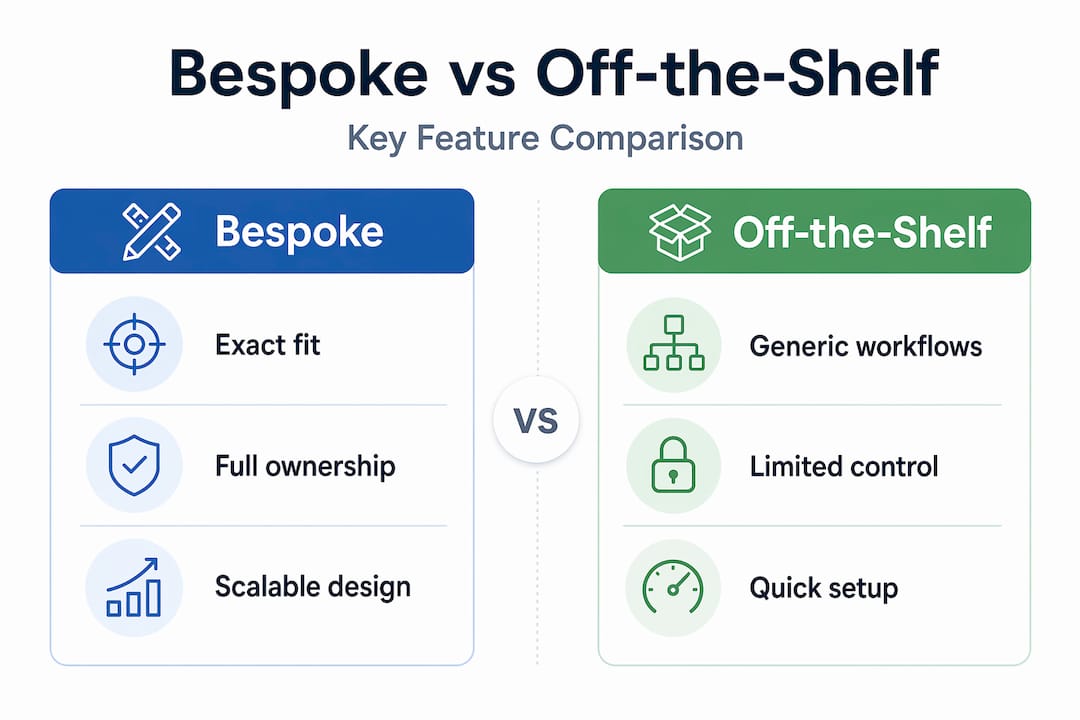
| Feature | Bespoke software | Off-the-shelf software |
|---|---|---|
| Fit to your workflows | Exact fit | Approximate fit |
| Ownership of code | Full ownership | Vendor-owned |
| Integration flexibility | Built to your stack | Limited by vendor APIs |
| Scalability | Designed for your growth | Constrained by product roadmap |
| Upfront cost | Higher | Lower |
| Long-term cost | Lower (no licensing fees) | Ongoing subscription costs |
| Feature relevance | 100% relevant | Often 60–70% relevant |
Off-the-shelf tools are not inherently bad. For commodity functions like accounting, email, or video conferencing, they work perfectly well. The problem arises when organisations try to force a generic tool onto a complex, differentiated process. That is where bespoke software solutions earn their place.
Advantages of bespoke software for businesses
The advantages of bespoke software extend well beyond simply “getting what you want.” They translate into measurable operational outcomes that compound over time.
- Operational efficiency. Businesses using tailored software solutions report up to 45% efficiency gains and error rate reductions of up to 85%. When your software is designed around how your team actually works, friction disappears.
- Competitive differentiation. Your proprietary workflows, pricing logic, and customer processes become embedded in software that no competitor can simply purchase. That is a genuine, durable advantage.
- Long-term ROI. The upfront investment is higher, but custom development generates up to 300% higher ROI compared to off-the-shelf alternatives for large companies. Licensing fees add up. Bespoke software does not charge you per seat, per module, or per API call.
- Scalability on your terms. You are not waiting for a vendor to add a feature to their product roadmap. Your software evolves when and how your business needs it to.
- Full IP ownership. Clients own the bespoke code and every line of logic within it. That means no vendor lock-in, no forced upgrades, and no surprises if a SaaS provider changes its pricing or shuts down.
Enterprises that have moved to custom builds report 35% higher operational efficiency and two to three times faster time-to-market for new products and services. The ROI payback period typically falls within 12 to 24 months, which is faster than many expect.
Pro Tip: Before committing to bespoke development, map your current workflows in detail and identify specifically where generic software is causing friction or costing you money. This exercise alone will clarify whether custom development is justified and will form the foundation of a strong requirements brief.

How AI is making bespoke software more affordable
Here is the development in the bespoke software space that most business leaders are not yet aware of: the cost of building custom software is falling sharply, and it is doing so at a time when virtually every other business expense is rising.
Agentic AI tools like Claude Code automate the repetitive, time-intensive coding tasks that previously made bespoke development expensive. The result is that senior engineers are now up to 50% more productive, meaning custom builds are delivered faster and at roughly half the previous cost. For small and medium-sized businesses, this is the shift that makes bespoke software viable for the first time.
The implications for how you approach the build-versus-buy decision are significant. Consider this:
- Reassess your assumptions about cost. If you priced bespoke software five years ago and ruled it out, the numbers may look very different today. Development timelines have compressed meaningfully.
- Recognise the deflationary trend is unusual. Software development is one of the only professional services categories getting cheaper in real terms. That window will not stay open indefinitely as demand catches up.
- Plan for SME competitive parity. Mid-market companies can now build the kind of customised software applications that were previously the exclusive domain of large enterprises with significant technology budgets.
- Maintain the human element. AI handles the repetitive scaffolding, but experienced engineers still provide architectural thinking, security rigour, and strategic alignment. The quality of human oversight matters more, not less, when AI is accelerating output.
“Software capability is becoming the defining competitive differentiator for organisations in 2026. The companies that own their technology will own their markets.”
This deflationary shift means the conversation is no longer “can we afford bespoke software?” For many organisations, it is now “can we afford not to have it?”
Common challenges and how to avoid them
Bespoke software projects fail far more often because of process failures than technical ones. Understanding where projects go wrong is as important as knowing their benefits.
- Misalignment with business goals. The most common cause of failed projects is poor strategic alignment. When leadership hands off a software project to IT without staying engaged, the resulting product solves the wrong problems.
- Treating it as a one-time purchase. Software is not a set-and-forget asset. Maintenance for bespoke systems covers adaptive, preventive, and corrective work tailored to your architecture. Organisations that do not budget for this end up with degraded, insecure systems within a few years.
- Vague requirements. Starting development without a detailed, documented requirements brief leads to scope creep, budget blowouts, and a product that disappoints everyone.
- Choosing the wrong partner. Price-shopping for the cheapest developer is a false economy. A poorly built bespoke system costs far more to maintain, fix, and eventually replace than one built properly the first time.
- No post-launch iteration plan. The first version of any software system should not be the last. Organisations that treat launch as the finish line miss most of the value.
Pro Tip: Define measurable success criteria before development begins. Know what “good” looks like: specific efficiency metrics, error rate targets, or integration milestones. These benchmarks keep development accountable and give you a clear basis for evaluating the outcome.
Practical steps for exploring bespoke software
If you are seriously considering tailored software solutions for your organisation, a structured approach dramatically improves your chances of a successful outcome.
- Audit your current workflows critically. Document what your teams actually do, not what the process chart says they do. Identify where generic software creates friction, manual workarounds, or data inconsistencies.
- Define requirements before approaching developers. Understanding how to define software requirements at scale is a discipline in itself. Write clear, prioritised specifications before any vendor conversation begins.
- Vet development partners rigorously. Ask for case studies in your industry, request to speak with past clients, and assess how well the team understands your business context, not just the technical brief.
- Plan for integration from the start. Map every system your new software needs to connect with. APIs, data formats, and authentication protocols should be scoped before development begins, not resolved mid-build.
- Budget for the full lifecycle. Development costs are only part of the equation. Factor in ongoing maintenance and support costs, which typically run at 15 to 25 percent of the initial build cost annually.
- Build in iteration cycles. Launch a minimum viable version, gather real user feedback, and plan subsequent development phases. Software that evolves with your business is far more valuable than software frozen at launch.
My take on bespoke software as a strategic investment
I have worked closely with a wide range of organisations making this decision, and the pattern I see most often is this: the businesses that treat bespoke software as an IT project tend to get mediocre results. The ones that treat it as a strategic investment in their operating model tend to get transformational ones.
The distinction is not about budget. It is about mindset. When leadership stays genuinely engaged throughout development, when the brief is tied directly to competitive goals rather than technical specifications, and when the development partner is chosen for strategic alignment rather than hourly rate, the outcomes are consistently stronger.
What I have found particularly compelling recently is the AI-driven cost reduction in this space. For years, bespoke software was a serious investment that many smaller businesses could not justify. That barrier is falling. The question I would put to any business leader reading this is whether your competitors are having that conversation while you are still managing workarounds in a generic SaaS tool.
The caution I would add is against expecting speed without structure. AI tools accelerate development, but they do not replace the thinking required upfront. The companies building proprietary software capability in 2026 are doing so deliberately, with clear goals and experienced partners guiding the process. Do not rush the planning to take advantage of cheaper build costs. The planning is where the real value is created.
— Liam
How Pixeldev builds software that lasts
If what you have read here resonates, Pixeldev works with businesses that want software built around their specific operational reality, not generic products adjusted to fit. Their senior team covers the full project lifecycle, from initial design through to ongoing maintenance and hotfixes, so the system you launch in year one is still performing in year five.
Pixeldev has delivered custom platforms for clients across wine retail, allied health, and other specialist sectors, each built to the exacting requirements of that business rather than adapted from a template. For organisations in the health space, their Avesa Health build is a strong example of what domain-specific, long-lived software actually looks like in practice. If you are ready to move beyond workarounds and generic tools, explore Pixeldev’s services to understand how a senior, specialist team approaches bespoke development and ongoing maintenance.
FAQ
What does bespoke software mean?
Bespoke software is a system built exclusively for one organisation’s specific needs, workflows, and goals. Unlike off-the-shelf software, it is not adapted from a general-purpose product but designed from the ground up.
How does bespoke software differ from off-the-shelf software?
Bespoke software is owned entirely by the client, built around their exact workflows, and scalable on their terms. Off-the-shelf software is vendor-owned, designed for a broad audience, and often requires manual workarounds for non-standard processes.
Is bespoke software worth the cost for small businesses?
Increasingly, yes. AI-assisted development tools have cut build costs by up to 50%, making customised software applications accessible to SMEs that previously could not justify the investment.
What are the main risks of bespoke software projects?
The greatest risks are poor strategic alignment, treating the software as a one-time purchase rather than an ongoing asset, and choosing a development partner based on price rather than capability. Clear requirements and engaged leadership significantly reduce these risks.
How long does bespoke software take to develop?
Timelines vary by complexity, but AI-assisted development has compressed delivery significantly. Many mid-scale projects now deliver initial working systems within three to six months, with iteration cycles following from there.