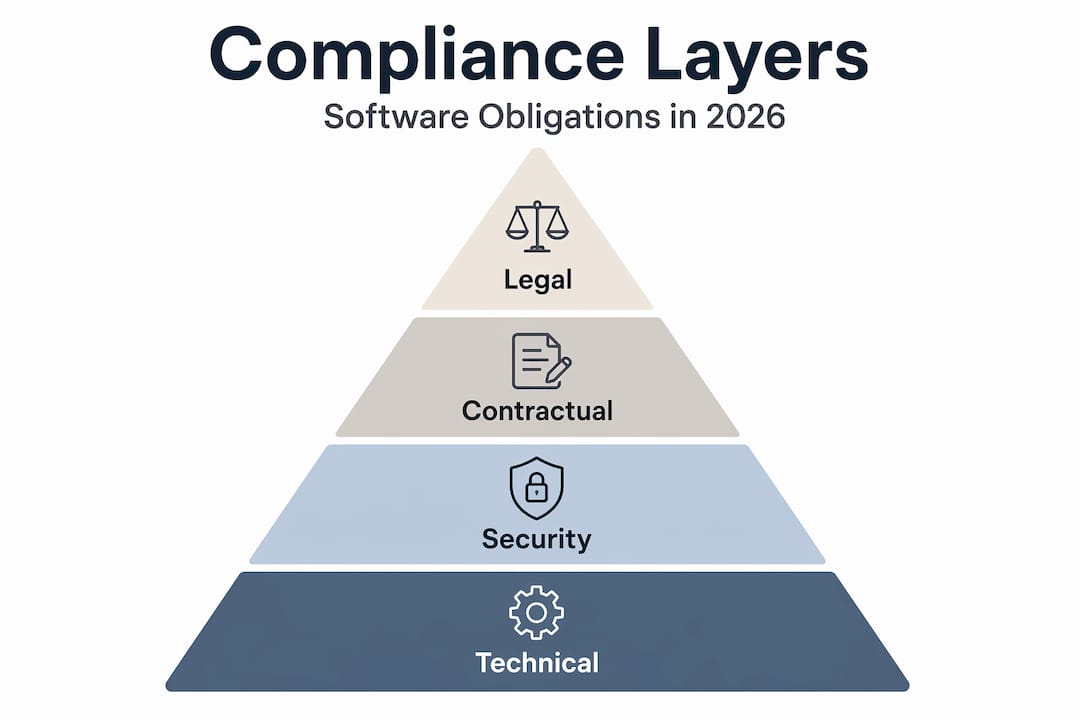
Software compliance requirements explained simply sounds like something your legal team handles once a year before an audit. It is not. For business owners, compliance officers, and IT managers, understanding software compliance means recognising that it sits at the intersection of contract law, cybersecurity, data privacy, and operational governance. Miss one layer and you are exposed to penalties, contract termination, or a regulatory investigation. This guide cuts through the noise and gives you a clear, practical picture of what compliance actually demands across licensing, security frameworks, and daily development practices.
Table of Contents
- Key takeaways
- Compliance frameworks and standards in 2026
- Software licence compliance and your obligations
- Secure software development under NIST SSDF
- Choosing the right compliance management tools
- Building a sustainable compliance programme
- My take on what compliance actually looks like
- How Pixeldev builds compliance into software from the start
- FAQ
Key takeaways
| Point | Details |
|---|---|
| Compliance covers multiple layers | Software compliance spans licensing, security standards, data privacy, and operational governance, not just a checklist. |
| Frameworks differ by industry | Regulations like GDPR, HIPAA, CMMC, and SOC 2 apply differently depending on your sector and the data you handle. |
| Licence scope triggers real risk | Breaching a software licence on user counts or geographic limits can trigger contract termination, regardless of technical functionality. |
| Security compliance needs embedding | Secure development practices must be built into your CI/CD pipeline, not added after deployment. |
| Gap assessments come first | Before building a compliance programme, assess where you currently stand against the relevant frameworks. |
Compliance frameworks and standards in 2026
Knowing which regulations apply to your organisation is the starting point for understanding software compliance. The landscape in 2026 is more layered than it was even three years ago, and different industries carry different obligations.
Here is a snapshot of the major frameworks and what they cover:
- GDPR governs the collection, processing, and storage of personal data for any organisation dealing with EU residents. It applies regardless of where your company is based.
- HIPAA applies to healthcare organisations in the United States and sets strict rules around protected health information in any software that touches patient records.
- FedRAMP is mandatory for cloud services sold to US federal agencies. The Moderate baseline covers 325 controls and applies to roughly 80% of federal cloud workloads, with continuous monitoring requirements built in.
- CMMC Level 2 requires organisations handling controlled unclassified information to meet 110 security controls across 14 control families under NIST SP 800-171, with mandatory third-party verification.
- SOC 2 and ISO 27001 are the dominant standards for SaaS providers and cloud platforms, forming part of a layered compliance approach that also includes GDPR, HIPAA, and PCI DSS.
One regulatory development worth flagging now is the EU AI Act. Enforcement begins on 2 August 2026, and it imposes transparency and documentation requirements on AI software tools, including code assistants and automated decision systems. If your development team uses AI tools in any capacity, these obligations already apply to your workflow.
The key takeaway here is that your compliance obligations are not defined by what your software does technically. They are defined by what data it touches, which markets it operates in, and which customers it serves.
| Framework | Primary focus | Who it applies to |
|---|---|---|
| GDPR | Data privacy | Any org handling EU personal data |
| HIPAA | Health data protection | US healthcare software |
| FedRAMP | Cloud security for government | US federal cloud vendors |
| CMMC | Unclassified defence data | US defence contractors |
| SOC 2 / ISO 27001 | Security and availability | SaaS and cloud providers |
Software licence compliance and your obligations
Licensing is where many organisations get caught out, because compliance clauses focus on scope and audit rights, not on whether the software is working correctly. Your software can perform perfectly and you can still be in breach.
Licence scope is typically measured across three dimensions: the number of authorised users, geographic restrictions on where the software can be deployed, and the number of permitted installations or instances. When any of these limits are exceeded, even unintentionally, the vendor can invoke audit rights and pursue remedies including contract termination or back-billing.
Here is how to stay on the right side of your licence agreements:
- Catalogue all software in use. Start with a complete software asset inventory across every team and device. Shadow IT, where employees install unlicensed tools independently, is one of the most common sources of licence breaches.
- Document licence entitlements clearly. Store licence agreements, purchase records, and entitlement certificates in a centralised location that compliance officers can access quickly during an audit.
- Monitor usage against entitlements regularly. Do not wait for a vendor audit request to check your compliance position. Monthly reviews of user counts and deployment records catch drift early.
- Know your audit rights exposure. Audit rights allow vendor inspections with no fixed frequency limits in most agreements. That means a vendor can request an audit at any point, so your documentation needs to be ready at all times.
- Maintain a compliance calendar. Track licence renewal dates, version upgrade deadlines, and any sunset clauses that affect your entitlement to use older versions.
Pro Tip: When reviewing a software agreement, pay close attention to the definition of “user.” Some licences count concurrent users, others count named users, and some count any individual who has ever accessed the system. The definition alone can change your compliance position significantly.
Compliance clauses in software agreements focus on scope measurement rather than service levels, which means the documentation burden falls entirely on you. Getting this right is less about tools and more about discipline.
Secure software development under NIST SSDF
For IT managers and development leads, the security dimension of software compliance is best understood through the NIST Secure Software Development Framework. NIST SP 800-218, known as the SSDF, is an outcome-based framework built around four pillars: Prepare, Protect, Produce, and Respond.

What makes the SSDF different from older compliance frameworks is its flexibility. It does not mandate specific tools or a rigid sequence of steps. Instead, it specifies the outcomes your development processes must achieve, which means you can adapt the SSDF to Agile and DevSecOps workflows without redesigning how your teams work.
Here is what each pillar demands in practice:
- Prepare: Define your security roles, establish a secure development environment, and document your software supply chain dependencies.
- Protect: Implement source code access controls, apply least privilege principles to development systems, and use integrity verification for code repositories.
- Produce: Conduct threat modelling during design, run automated vulnerability scanning in your CI/CD pipeline, and review third-party components for known vulnerabilities before integration.
- Respond: Establish a documented process for receiving and addressing vulnerability disclosures, including timelines for patching and communication with affected parties.
Embedding automated compliance gates in DevSecOps pipelines is significantly more reliable than manual checks. When a compliance requirement is enforced at the pipeline level, it cannot be bypassed by a time-pressured developer pushing a release late on a Friday.
Pro Tip: Start with a gap assessment against the SSDF before trying to implement controls. A gap assessment tells you which practices you already satisfy, which need improvement, and where your highest-risk gaps sit. Without it, compliance programmes spread effort too thinly and miss the controls that matter most.
Understanding software compliance in a development context means recognising that defining your custom software requirements at the outset is directly tied to how easily you can embed compliance controls later.
Choosing the right compliance management tools
A software compliance checklist is only as useful as the system that keeps it current. The tools you use to manage compliance have a significant impact on how well your programme works in practice.
The most common mistake organisations make is adopting a collection of siloed modules from different vendors. Fragmented modules create fragmented data, and fragmented data produces blind spots in your risk picture. A vendor selling you separate tools for policy management, incident tracking, and licence monitoring is creating a problem, not solving one.
When evaluating compliance software, look for these characteristics:
- Unified architecture: All compliance data should feed into a single platform where risk can be assessed holistically, not in isolation.
- Genuine automation: Automation should enforce controls and trigger workflows, not just send reminder emails. If the tool cannot act on a finding, it is adding noise rather than reducing risk.
- Proactive risk management: Good compliance software identifies emerging risks before they become incidents, rather than logging problems after the fact.
- Security of the platform itself: Your compliance tool holds sensitive audit data and control evidence. Its own security posture must meet the standards you are trying to achieve.
“Choosing compliance software requires ensuring the platform offers unified architecture, proactive risk management, genuine automation, and robust data security. Fragmented modules, reactive workflows, and poor integration cause inefficiency and risk.” — GANintegrity
Scalability and integration with your existing IT systems are not optional features. They are the difference between a compliance tool that grows with your organisation and one that becomes a liability within two years.
Building a sustainable compliance programme
Understanding the regulations is one thing. Building the internal processes to stay compliant over time is another challenge entirely. Here is a practical sequence for organisations at any stage of their compliance maturity:
- Conduct a gap assessment. Compare your current controls, documentation, and policies against the frameworks relevant to your industry. Starting with a gap assessment lets you prioritise the highest-risk areas rather than trying to address everything simultaneously.
- Establish clear roles and ownership. Compliance without accountability fails. Assign named owners to each control area and define escalation paths for when something falls outside compliance.
- Document policies and train your team. Written policies are not bureaucratic overhead. They are the evidence your organisation needs during an audit. Pair them with regular training so that compliance behaviour is consistent, not aspirational.
- Set up a compliance calendar and dashboard. Track renewal dates, audit cycles, review periods, and regulatory deadlines in one place. A dashboard that gives management real-time visibility into compliance status is worth more than a monthly PDF report.
- Maintain audit trails and documentation. Every control decision, exception, and review should be recorded. The enterprise role of software documentation extends directly into compliance, where evidence of due diligence is as important as the controls themselves.
- Run continuous improvement cycles. Compliance is not a project with an end date. Schedule regular reviews of your control effectiveness, update your risk register as the regulatory environment changes, and treat each audit finding as input to a better programme.
The organisations that stay compliant over time are not the ones with the most complex programmes. They are the ones with the clearest processes.
My take on what compliance actually looks like
I have seen organisations spend months implementing compliance tools and producing documentation, only to fail an audit because nobody had clear ownership of the controls they had written down. That is the most common failure mode in compliance programmes. The paperwork exists. The accountability does not.
What I have learnt working across software development and compliance contexts is that overly complex restrictions and unclear governance are the primary reasons programmes fall apart. Adding more controls rarely fixes a governance problem. Simplifying roles and making ownership visible does.
My honest view is that most organisations should spend less time on compliance tooling and more time on two things: understanding exactly which regulations apply to them, and assigning real accountability for each control area. The rest follows more naturally than most compliance consultants would have you believe.
The regulatory environment is shifting fast, particularly with AI regulations entering enforcement in 2026. That means compliance cannot be a once-a-year exercise. It needs to be a standing item in your operational rhythm, not a fire drill before an audit.
— Liam
How Pixeldev builds compliance into software from the start
If you are building or maintaining custom software and compliance is a non-negotiable requirement, the architecture decisions made at the beginning of the project determine how easily you can satisfy audits, meet security standards, and adapt to regulatory changes later.
Pixeldev designs and maintains software systems with compliance considerations embedded from the initial specification phase. That means documentation structures, access control frameworks, and audit trail capabilities are built into the platform rather than retrofitted when a regulator comes knocking. Whether your obligations sit under NIST SSDF, SOC 2, or data privacy legislation, Pixeldev’s senior team understands how to translate those requirements into durable technical architecture.
If you are working through what compliance means for your specific software context, the Pixeldev services overview is a practical starting point, and the OnCloudWine case study shows what a compliance-aware build looks like in practice.
FAQ
What are software compliance requirements?
Software compliance requirements are the legal, contractual, and security obligations that govern how software is developed, licensed, and operated. They span regulations like GDPR and HIPAA, licence agreements, and security frameworks such as NIST SSDF and SOC 2.
Why does licence compliance matter if the software works fine?
A software licence breach, such as exceeding user counts or deploying outside permitted geographies, can trigger contract termination regardless of technical performance. Vendors hold audit rights to inspect compliance at any time under most agreements.
What is the NIST SSDF and who needs to follow it?
The NIST Secure Software Development Framework (SSDF) is an outcome-based security standard covering four practice areas: Prepare, Protect, Produce, and Respond. It is required for federal software vendors and increasingly referenced as a baseline by regulated industries.
How do I start a software compliance programme?
Begin with a gap assessment against the frameworks relevant to your industry. This identifies your highest-risk control gaps and lets you prioritise effort, rather than trying to address every requirement simultaneously without context.
Does the EU AI Act affect my software compliance obligations?
If your organisation uses AI-powered development tools or delivers software with automated decision-making features, the EU AI Act enforcement from August 2026 introduces transparency and event-logging requirements that form part of your software compliance obligations.