Sustainable software development is one of the most misunderstood concepts in the industry. Most developers assume it means running servers on renewable energy and calling it done. That is a fraction of the picture. What is sustainable software development, really? It is a discipline that spans architecture decisions, coding patterns, operational scheduling, and measurement frameworks, all working together to reduce the carbon and resource cost of every computation your software performs. For developers and project managers building systems meant to last, this is not a future concern. It is a current design responsibility.
Table of Contents
- Key takeaways
- What is sustainable software development?
- Measuring what you build
- Sustainable practices across the software lifecycle
- Challenges and real trade-offs
- My honest take on where teams get this wrong
- Build software that earns its footprint
- FAQ
Key takeaways
| Point | Details |
|---|---|
| Sustainability goes beyond energy sources | Software design, architecture, and code efficiency directly determine how much energy a system consumes. |
| SCI metric is the standard measurement tool | The Software Carbon Intensity formula quantifies carbon per functional unit, making efficiency improvements visible and trackable. |
| Lifecycle practices matter most | Sustainable gains come from design, coding, operations, and data management together, not from optimising code alone. |
| Trade-offs require cross-team collaboration | Balancing performance, scalability, and emissions needs developers, architects, and project managers working from shared goals. |
| Sustainability improves business outcomes | Leaner, well-architected software delivers lower costs, better performance, and easier maintenance alongside reduced emissions. |
What is sustainable software development?
Sustainable software development is the practice of designing, building, and operating software in a way that minimises its environmental impact while remaining technically sound and commercially viable. Carbon efficiency sits at its core. Every time your application processes a request, renders a page, or queries a database, it consumes energy. That energy carries a carbon cost depending on where and when it is generated.
The principles that define this approach include:
- Energy efficiency: Write code and architect systems that accomplish tasks with the least computational work required.
- Resource optimisation: Avoid over-provisioning infrastructure. Size cloud resources to actual load rather than theoretical peaks.
- Scalability with intent: Design for growth without assuming scale means unlimited resource consumption.
- Longevity: Build software that lasts. Disposable systems that require full rewrites every few years waste the embodied carbon of the hardware they run on.
- Carbon awareness: Understand that the same workload produces different emissions depending on when and where it runs.
There is an important distinction between carbon intensity and total emissions. A system that grows ten times in usage might reduce its carbon intensity per transaction significantly, yet still increase its total emissions. SCI as a rate metric is designed to surface efficiency improvements independently from business scale. This distinction matters enormously for project managers reporting on environmental progress. Growth should not mask engineering regression.
Sustainable software engineering is not a checklist. It is a set of values embedded into how your team makes decisions at every phase of a project.
Measuring what you build
You cannot manage what you cannot measure. The Green Software Foundation’s Software Carbon Intensity standard gives teams a concrete, repeatable method for quantifying a system’s carbon footprint per unit of business value.
The SCI formula is expressed as:
SCI = ((E × I) + M) / R
Where E is energy consumed in kilowatt-hours, I is the carbon intensity of the electricity grid, M is the embodied emissions of the hardware, and R is the functional unit. A functional unit might be one API call, one user session, or one completed transaction. The choice of R is where measurement gets interesting and specific to your system.
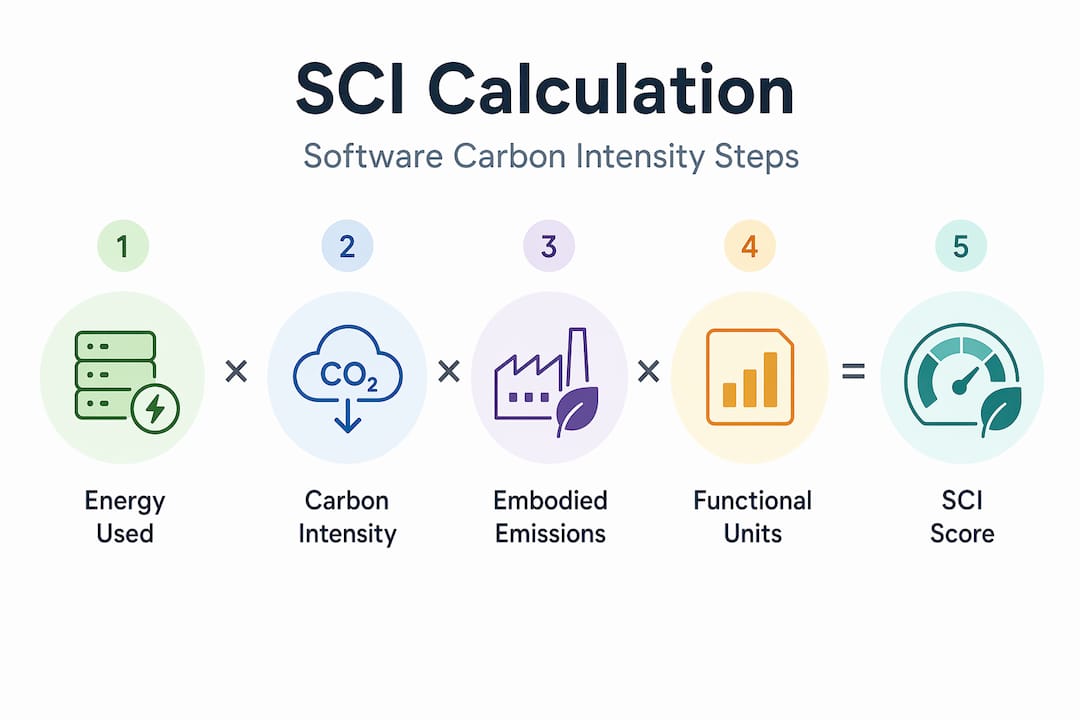
| Component | What it measures | Example value |
|---|---|---|
| E (Energy) | Power drawn during operation | 18W |
| I (Grid intensity) | Carbon per kWh of electricity | 332 gCO₂eq/kWh |
| M (Embodied emissions) | Hardware manufacture and disposal carbon | 211,000 gCO₂e |
| R (Functional unit) | Business-value unit being measured | 1 request |
Choosing functional units aligned with real business value makes version comparisons meaningful. A payment API processing 50 million transactions annually can achieve an SCI score under 1 gCO₂e per transaction. That is a concrete, credible target, not an aspiration.
Instrumentation does not require a major refactor. Non-invasive runtime profilers can measure carbon intensity with zero or minimal code changes, making it practical to add measurement into staging environments immediately.
Pro Tip: Start measuring in your staging environment before touching production. Establish a baseline SCI score for your most critical user flow first. That single number gives you a reference point that every subsequent release can be compared against.
Reporting matters for compliance too. The European Union’s Corporate Sustainability Reporting Directive (CSRD) is pushing organisations to report on Scope 3 emissions, which includes software. Teams that build measurement into their development process now will be far better positioned than those scrambling to produce retrospective estimates.
Sustainable practices across the software lifecycle
Sustainable software practices are not confined to the operations team or a single sprint at the end of a project. They run through every phase of delivery.
Architecture and design
The decisions made on a whiteboard before a single line of code is written have the greatest long-term impact. When defining custom software requirements, consider how data flows through the system and where unnecessary computation accumulates.
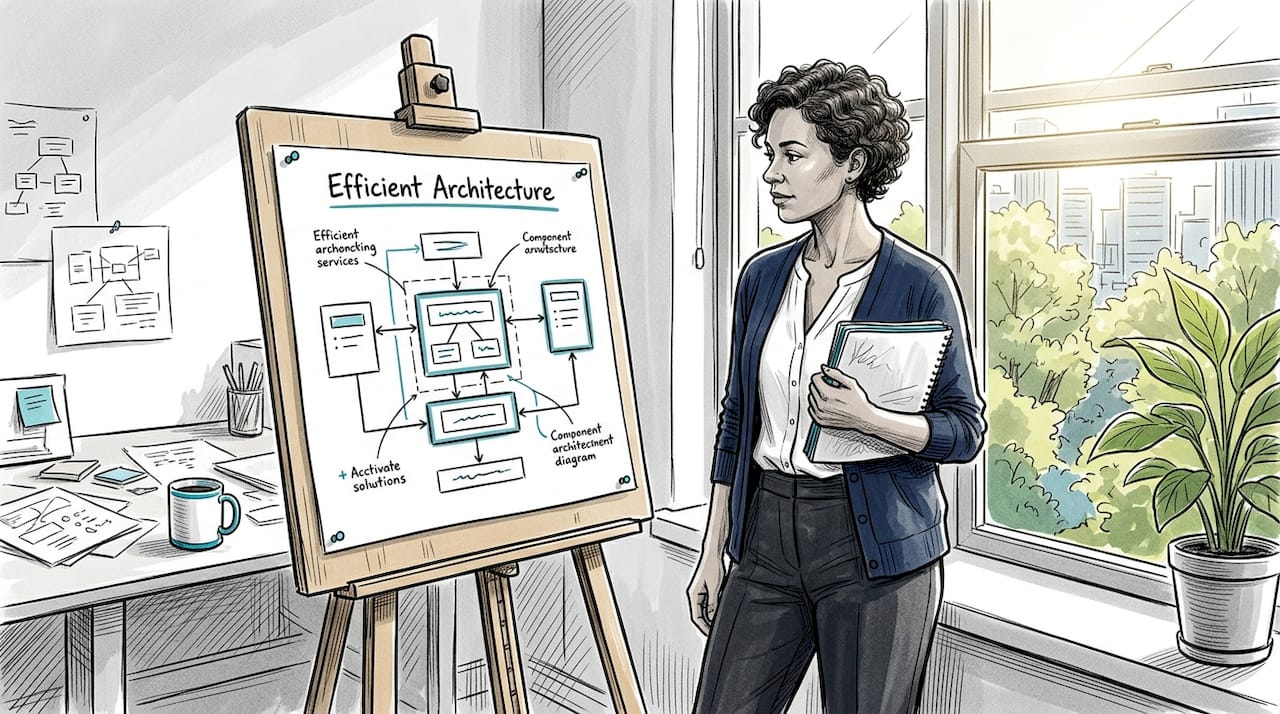
Microservices can help or hurt depending on their implementation. Serverless functions eliminate idle compute costs for infrequent workloads. Monoliths are sometimes the greener choice because they avoid network overhead between services. There is no universal answer. The right architecture is the one that matches actual load patterns with minimal resource waste.
Coding for efficiency
Lean code matters. Efficient algorithms reduce CPU cycles. Fewer dependencies mean smaller attack surfaces and less memory consumption. Language choice has a real impact too. Compiled languages generally consume less energy per computation than interpreted ones, though the difference shrinks when you factor in developer time and system architecture.
Here is a practical sequence for writing more sustainable code:
- Profile before optimising. Understand where compute time is actually spent before changing anything.
- Reduce unnecessary data transfer. Every byte sent over a network costs energy on both ends.
- Cache aggressively but deliberately. Serving cached responses is orders of magnitude cheaper than recomputing them.
- Eliminate dead code and unused dependencies. They consume build time, memory, and occasionally runtime cycles.
- Choose efficient data formats. Binary protocols beat verbose JSON for high-frequency internal communication.
Pro Tip: Review your application’s largest database queries alongside your SCI baseline. Poorly indexed queries are often the single largest source of avoidable compute waste, and fixing them delivers both performance and sustainability gains simultaneously.
Operations and scheduling
Carbon-aware computing shifts non-urgent workloads to times when the electricity grid is running on cleaner energy. Batch processing jobs, model training runs, and report generation do not need to happen at peak carbon intensity hours. Major cloud providers expose carbon intensity data through APIs, making this kind of scheduling practical to implement.
Cloud resource rightsizing is equally significant. Optimising code without addressing infrastructure misses some of the biggest environmental wins available. An oversized database instance running at 5% CPU capacity all day is a more pressing sustainability problem than a slightly inefficient sorting algorithm.
Good software documentation also supports sustainability. Systems that are clearly documented are easier to maintain, extend, and optimise. Undocumented systems get rewritten. Rewrites waste everything that came before them.
Challenges and real trade-offs
Sustainable software development is not straightforward to adopt, and pretending otherwise sets teams up for frustration.
The most common challenges practitioners encounter include:
- Visibility gaps: In shared cloud infrastructure, attributing emissions to a specific service or team is genuinely difficult. You often measure proxies rather than direct carbon figures, and those proxies carry assumptions.
- Performance versus sustainability tension: A more sustainable architecture is not always the fastest one. Caching reduces compute but introduces consistency complexity. Batch processing reduces peak load but delays results. These are real trade-offs, not problems to be dissolved with the right framework.
- Organisational silos: Developers optimise code. Infrastructure teams size resources. Finance approves cloud spend. Without a shared sustainability goal, each team optimises locally while the system-level emissions remain unchecked.
- Greenwashing risk: Reporting an SCI score without understanding its assumptions is meaningless. Selecting a functional unit that flatters your numbers without reflecting real user value is a form of greenwashing, even when it is unintentional.
- Integration into existing workflows: Sustainability goals need to sit inside your definition of done, your sprint reviews, and your architecture decision records. If it exists only in a separate report, it will not change behaviour.
Collaboration across developers, architects, and project managers is not optional. Sustainable software requires trade-offs across different layers of the stack. No single role has enough visibility to make those calls alone.
My honest take on where teams get this wrong
I have worked with development teams that genuinely want to build greener software but spend months debating which carbon calculator to use while their cloud bill tells them their infrastructure is 40% idle. The measurement conversation is important, but it can become a substitute for action.
In my experience, the biggest wins come from the boring work: rightsizing instances, removing unused services, fixing the queries that have been running inefficiently for two years because nobody prioritised them. These changes reduce emissions and improve performance and cut costs. They rarely get scheduled because they are not visible enough to make it into a sprint.
What I have learned is that sustainable software development needs a sponsor at the project manager level, not just enthusiasm at the developer level. Without someone translating carbon efficiency into business terms, it stays as good intention. The teams I have seen make real progress embed a sustainability check into their regular architecture reviews and treat their SCI score the same way they treat response time: as a metric that matters.
The future of environmentally conscious development is not a specialisation. It is a baseline expectation, the same way security and accessibility have become. Teams that treat it as optional today are accumulating technical and reputational debt they will have to repay later.
— Liam
Build software that earns its footprint
At Pixeldev, we build software designed to last. That means making architecture and design decisions from the start that reduce waste, not just deliver features. Every project we take on goes through a process that considers resource efficiency, maintainability, and long-term operational cost as first-class concerns, not afterthoughts.
If you are planning a new platform or reviewing an existing one, the examples of robust web applications we have worked on show what durable, efficient software actually looks like in practice. And if you are at the stage of defining what your system needs to do, our approach to custom software requirements ensures sustainability is built into the brief, not bolted on at the end. Explore what Pixeldev offers at pixeldev.com.au/services/ and see how we approach building software that is built to last.
FAQ
What is sustainable software development in simple terms?
Sustainable software development is the practice of building software that consumes the minimum energy and resources needed to deliver its function, reducing carbon emissions across its entire lifecycle from design through to operations.
How is software carbon intensity calculated?
The SCI formula is SCI = ((E × I) + M) / R, where E is energy consumed, I is grid carbon intensity, M is embodied hardware emissions, and R is the functional unit such as one user request or transaction.
Is sustainable software development the same as green programming?
They refer to the same broad goal. What is green programming, in practice, describes the coding-level aspects of sustainability, while sustainable software engineering covers the full lifecycle including architecture, operations, and measurement.
How do project managers integrate sustainability into software projects?
Project managers can add sustainability by including SCI targets in the definition of done, scheduling regular architecture reviews that include carbon efficiency, and treating emissions metrics with the same priority as performance benchmarks.
What are the biggest barriers to adopting sustainable software practices?
The main barriers are poor visibility into emissions in shared infrastructure, organisational silos between development and operations, and the absence of sustainability goals in project planning and sprint reviews.