Most startup founders assume they are already running flexible software. They are not. The tools feel customisable on the surface, but static software assumptions about standardisation quietly generate friction the moment your processes diverge from the template. That friction compounds. Manual workarounds multiply. Data reconciliation eats hours. And suddenly a tool chosen for convenience is the ceiling on how fast you can grow. This guide covers software flexibility for startups explained from first principles, including architecture, tool selection, and what separates genuinely adaptable systems from ones that just look the part.
Table of Contents
- Key takeaways
- Software flexibility for startups explained
- Architectural approaches that enable flexibility
- Choosing and implementing flexible tools
- Managing change, AI, and governance
- A framework for assessing software flexibility
- My take on what founders consistently get wrong
- How Pixeldev builds for flexibility from day one
- FAQ
Key takeaways
| Point | Details |
|---|---|
| Flexibility is architectural, not cosmetic | True software flexibility lives in data structures and business logic, not just configurable dashboards. |
| Modular design reduces risk | Incremental migration via the strangler pattern lets you modernise without halting operations. |
| Tool selection shapes your runway | Choosing fit-for-purpose, adaptable tools early prevents compounding friction as you scale. |
| Governance keeps adaptability safe | Versioning, audit trails, and rollback windows protect you when software behaviour changes. |
| Adaptive software reflects your workflows | Software should bend to how your business operates, not force your team to work around it. |
Software flexibility for startups explained
Software flexibility for startups means your systems can change shape as your business does. That sounds obvious. In practice, most founders conflate configuration with flexibility, and those are not the same thing.
Configuration lets you rename a field or change a colour scheme. Flexibility means your software can accommodate a completely new workflow, a different pricing model, or an additional product line without requiring a rebuild from scratch. The distinction matters enormously when you are six months in and realise your initial assumptions about how customers buy were wrong.
Here is what separates flexible from static software in practical terms:
- Data structures that reflect your logic. Adaptive software builds planning logic and business rules around how your specific operation runs, not around a generic template another company designed.
- Update pathways that are immediate. You should be able to turn an insight into a system change without exporting data, reconciling spreadsheets, and waiting for a developer sprint.
- Alignment with rapid iteration. Startups pivot. Your software needs to support that without creating a six-week change request queue.
- Operational efficiency gains. Genuinely flexible tools reduce administrative overhead because your team stops working around the software and starts working with it.
- Competitive advantage through speed. When your systems adapt faster than your competitors’ do, you can test, learn, and ship faster. That is a real edge.
The importance of software adaptability compounds over time. A rigid tool that costs you two hours of workarounds per week is costing you over a hundred hours a year, and those hours scale with headcount.
Architectural approaches that enable flexibility
Understanding why a system is flexible requires looking at what is underneath the surface. Most discussions about flexible software solutions for startups stop at tool comparisons. The more useful conversation is about architecture.
Adaptive software versus static templates
Adaptive software is designed to reflect your specific business logic. A static system enforces the assumptions baked in by its original developers. The difference becomes visible when your workflows are non-standard. If you are running a subscription model with unusual billing cycles, or a services business with project-based revenue recognition, a static tool will fight you at every step.

Adaptive systems let you define planning logic and data structures that mirror how your operation actually runs. That means less translation overhead between “what the business does” and “what the software records.”
Governed write-back
One underappreciated capability is governed write-back. This mechanism allows teams to update forecasts and plans directly inside the reporting environment, creating traceable, auditable changes without exporting to a spreadsheet, editing, and reimporting. For startups running fast planning cycles, this turns a reporting tool into an active planning system. The result is that insights lead directly to updated plans, not to a to-do list that sits in someone’s inbox.
Modular design and the strangler pattern
| Approach | Description | Best for |
|---|---|---|
| Monolithic system | All features in one codebase, tightly coupled | Early MVP stage with minimal complexity |
| Modular architecture | Independent services or modules with defined interfaces | Growth-stage startups needing adaptability |
| Strangler pattern migration | Incremental feature extraction, old and new run side-by-side | Teams migrating away from rigid legacy systems |
The strangler pattern involves extracting features from a monolithic system one at a time, running old and new implementations side-by-side, and maintaining a rollback window so any failed migration can be reversed without a crisis. This approach reduces deployment risk significantly compared to “big bang” rewrites that try to replace everything at once.
The payoff is measurable. Incremental migration moves deployment frequency from one or two releases per week to three to five per day, cuts test suite runtimes substantially, and reduces mean time to recovery. Those numbers translate directly to faster product iteration and lower engineering stress.
Pro Tip: When evaluating software vendors, ask specifically whether they support modular extension or API-first architecture. A “yes” to configuration but a “no” to modular extension is a red flag for long-term flexibility.
Choosing and implementing flexible tools
Understanding architecture is one thing. Knowing which tools to actually put in front of your team is another. Effective software stack choices made early in a startup’s lifecycle have a disproportionate impact on speed, collaboration quality, and how long your runway lasts.
The goal when evaluating tools is not to find the feature-richest option. It is to find the option that bends most readily to your evolving needs without creating technical debt.
Categories worth prioritising
- Technical workflow tools. Products like Linear allow engineering teams to manage tasks in ways that adapt to their specific sprint structure and issue taxonomy, rather than forcing them into a generic project template.
- Collaboration platforms. Notion and similar tools let you build documentation, wikis, and project trackers that reflect your actual team structure. The key is that the information architecture is yours to define, not the vendor’s.
- Operations and workflow management. Tools like Asana support non-linear workflows where tasks branch and depend on each other in ways that reflect real operational complexity.
- Financial and accounting software. Flexible accounting tools like Xero allow startups to adapt reporting structures as the business model evolves, which matters enormously when you move from a single product to a portfolio.
Evaluating adaptability versus convenience
The trap most founders fall into is choosing tools for immediate convenience. The tool is familiar, the setup is fast, the free tier covers current needs. Six months later, the same tool is generating workarounds because it never supported the workflow you actually developed.
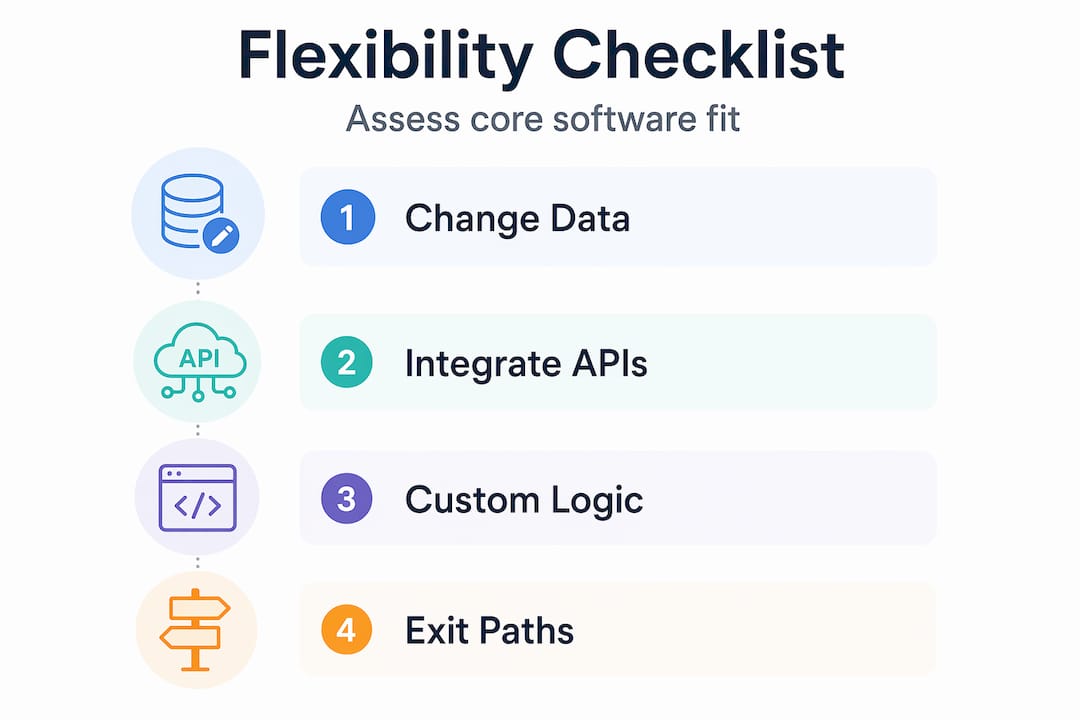
When assessing how to choose flexible software, ask three questions before committing. First, can the data model be changed after initial setup without losing historical data? Second, does the tool expose an API that lets you connect it to other systems as your stack grows? Third, is there a clear migration path out of the tool if you outgrow it? A tool that cannot answer yes to all three is a liability as you scale.
Pro Tip: Run a two-week “edge case stress test” before committing to any core operational tool. Map out three to five unusual scenarios your business might encounter and see how the tool handles them. This surfaces rigidity far faster than a standard trial period.
Managing change, AI, and governance
As your software environment grows more complex, maintaining flexibility requires active governance rather than passive tool selection. This is where many founders lose their grip on what their systems are actually doing.
-
Implement versioning from day one. Every significant change to system behaviour should be versioned and documented. Governance frameworks that enforce audit trails and semantic verification prevent ungoverned drift, where the system gradually does something different from what was intended and no one can pinpoint when or why.
-
Build rollback windows into your deployment process. Whether you are migrating software or updating AI-assisted workflows, the ability to revert a change without a production incident is not optional. It is the safety net that makes rapid iteration survivable.
-
Treat AI-driven adaptations with particular care. Software change management for AI-assisted systems requires versioning and rollback capabilities specifically because AI modifications can alter system behaviour persistently in ways that are hard to audit retrospectively. Scope isolation for AI components prevents one change from cascading unexpectedly.
-
Measure continuously. Flexibility is not a one-time decision. Set baseline metrics for deployment frequency, error rates, and manual workaround hours. Review them quarterly. Degradation in any of these signals that a tool or architecture choice is becoming a constraint.
-
Prepare your team, not just your stack. The benefits of agile software for startups are only realised if the team has the mindset and processes to exploit the flexibility on offer. Technical capability without cultural adoption is wasted investment.
A framework for assessing software flexibility
Before committing to any significant software decision, run through this structured assessment.
| Assessment area | Questions to ask | What to look for |
|---|---|---|
| Data model | Can structures be modified post-launch? | Schema flexibility, no locked fields |
| Integration | Does an open API exist? | REST or GraphQL support, webhook capability |
| Migration | Is there a documented exit path? | Data export options, portability standards |
| Governance | Are audit trails and version history available? | Changelog access, rollback capability |
| Scalability | Has the tool been used at 10x your current scale? | Case studies, performance benchmarks |
Software customisation for new businesses does not require building everything from scratch. It requires choosing systems whose architecture is designed to grow with you, then governing that growth deliberately. The role of documentation in that governance is more important than most founders realise. Systems that are well-documented are systems that can be safely changed.
My take on what founders consistently get wrong
I have watched a lot of startups make software decisions that looked sensible in month one and became anchors by month twelve. The pattern is almost always the same. The founder chose the most convenient tool available, assumed that convenience equalled adaptability, and did not look at the architecture underneath.
What I find genuinely under-discussed is that software flexibility is not really a product feature. It is a property of a system’s design. You can take two tools with identical feature lists and one will bend to your business while the other fights you at every turn. The difference is entirely in how the data model, the API surface, and the extension mechanisms were built.
The founders who get this right tend to treat software selection as an architectural decision, not a procurement decision. They ask about data portability before they ask about the dashboard. They look at the strangler pattern not as a migration tactic but as a signal about whether a vendor’s system was designed to be replaced gracefully when the time comes.
The uncomfortable truth is that the best flexible software is often the most expensive at the start. Custom-built or highly adaptable systems require more upfront investment than off-the-shelf tools. But the compounding cost of rigidity, measured in workaround hours, missed pivots, and eventual rewrites, almost always exceeds that initial investment. I have yet to see a founder who regretted building on a flexible foundation. I have seen many who regretted the opposite.
— Liam
How Pixeldev builds for flexibility from day one
If the architecture arguments above have you thinking about what your current stack cannot do, that is a productive instinct to act on.
Pixeldev specialises in bespoke software built to adapt. Not tools bolted together and hoped for the best, but systems designed from the ground up to support how your business actually operates. The OnCloudWine platform is a good example of what this looks like in practice: a custom web platform built for a fast-scaling business that needed its software to grow with it, not constrain it. If you are at the stage where flexibility is becoming a genuine business concern, Pixeldev’s software design and maintenance services are worth a look.
FAQ
What does software flexibility mean for a startup?
Software flexibility means your systems can accommodate new workflows, business models, and scale requirements without requiring a full rebuild. It is primarily an architectural property, not a feature you toggle on in settings.
How do I choose flexible software for my startup?
Prioritise tools with open APIs, modifiable data models, and documented exit paths. Ask vendors specifically about extension mechanisms and whether the data model can change after initial setup without data loss.
What is the strangler pattern in software migration?
The strangler pattern is an incremental migration approach where you extract features from an existing system one at a time, running old and new implementations side-by-side with a rollback window. It significantly reduces the risk of migrating away from rigid or monolithic systems.
Why does software adaptability matter more as startups scale?
As a startup grows, the gap between generic software templates and your specific processes widens. Rigid tools generate increasing workaround overhead and slow your ability to respond to market changes, making adaptability a direct competitive factor.
How does AI change software flexibility requirements?
AI-driven adaptations can alter system behaviour persistently and in ways that are difficult to reverse. Effective flexibility in AI-assisted environments requires versioning, scope isolation, and rollback capabilities specifically designed to govern how AI modifies system behaviour over time.