Small business software ROI explained for owners
Most small business owners think software ROI is straightforward: pay the subscription, watch the revenue climb. The reality is far messier. Getting small business software ROI explained properly means looking at costs you never see advertised and benefits that take months to appear. Ignore that gap, and you will invest thousands in tools that technically “work” but never pay off. This guide walks you through the real formula, the full cost picture, how to quantify what you gain, and how to use all of it to make smarter investment decisions going forward.
Table of Contents
- Key takeaways
- Small business software ROI explained: the core formula
- The real cost of business software
- Quantifying what you actually gain
- How to calculate software ROI step by step
- Applying ROI insights to smarter decisions
- My take on where small businesses go wrong
- How Pixeldev helps you get more from your software investment
- FAQ
Key takeaways
| Point | Details |
|---|---|
| Use the full ROI formula | Calculate ROI as net profit divided by total investment cost, multiplied by 100, not just subscription versus revenue. |
| Hidden costs multiply quickly | True first-year software costs often run 2 to 5 times the subscription price once you add setup, training, and lost productivity. |
| Quantify both tangible and intangible benefits | Include error reduction, staff time saved, and risk avoided alongside direct revenue gains to get an honest return figure. |
| Align ROI timeframes to software type | ERP systems may take 16 months or more to pay back; marketing tools can show returns within weeks. |
| Monitor ROI continuously | A single upfront calculation is not enough. Revisit your figures quarterly as costs and benefits shift with actual usage. |
Small business software ROI explained: the core formula
ROI stands for return on investment. In plain terms, it answers one question: did this purchase make you more than it cost? The standard formula, as defined by Xero, is:
ROI = (Net profit ÷ Cost of investment) × 100%
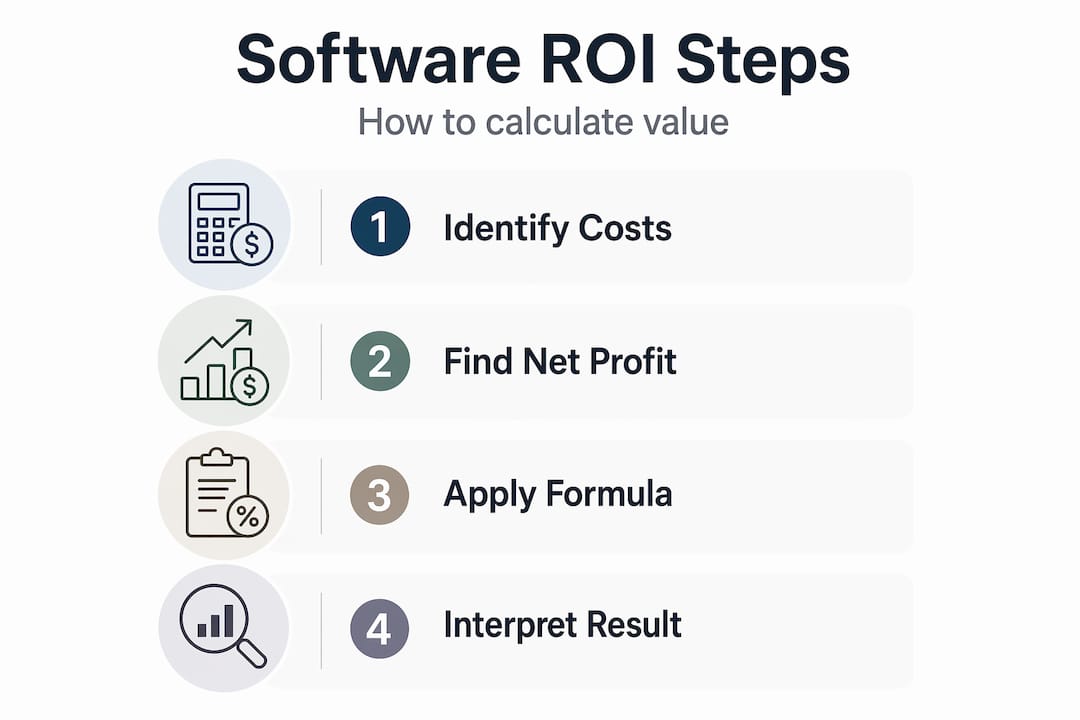
Net profit here means the total financial gain you received from the software, minus every cost associated with owning and running it. If a CRM system generated $20,000 in additional revenue and cost you $8,000 all up, your ROI is (($20,000 minus $8,000) ÷ $8,000) × 100 = 150%. Clean, simple, compelling.
What counts as a good ROI?
Benchmarks help you interpret your number. Average ROI across many industries sits around 5 to 7%, with 10% or more considered strong and anything above 20% excellent. Software investments can far exceed these figures because the marginal cost of scaling a digital tool is low once it is set up. However, benchmarks shift depending on your industry, the risk profile of the investment, and how long you are willing to wait.
That last point matters more than most owners realise. Payback period, the time it takes to recover your initial outlay, is just as useful as the ROI percentage itself. A tool returning 80% ROI over three years is very different from one returning 80% in six months, especially if your cash flow is tight. When you look at types of small business web solutions, payback period varies enormously across categories, and knowing this upfront prevents nasty surprises.
The real cost of business software
Here is where most calculations go wrong. You see “$99 per month” and multiply by 12. That gives you $1,188. Done, right? Not even close. True first-year costs for AI tools and similar software regularly total 2 to 5 times the advertised subscription price once you factor in everything actually required to get value from the tool.
A more honest cost model includes:
- Subscription or licence fees. The base cost, usually quoted monthly or annually.
- Implementation and setup. Time your team spends configuring the system, migrating data, and testing. At even a conservative hourly rate, this adds up fast.
- Onboarding and training. Whether you pay for formal training or simply absorb the hours your staff spend learning the tool, this is a real cost.
- Temporary productivity loss. For the first few weeks or months, staff output typically drops while they adjust. That lost productivity has a dollar value.
- Ongoing maintenance and support. Updates, troubleshooting, renewals, and any customisation work you need done later.
- Opportunity cost. The money you spent here could have funded something else. If hiring an extra part-time staffer would have generated more return, your software investment has a hidden competitor. AI tool ROI is frequently overestimated precisely because this comparison never gets made.
To put this in concrete terms: a $99 per month AI writing tool does not cost $1,188 per year. Once you add integration work, staff training time, and a productivity dip during adoption, the real first-year cost can land between $1,388 and $1,988.
Pro Tip: Build a cost spreadsheet before you buy, not after. List subscription fees, estimated setup hours at your average hourly labour rate, and a realistic training period. This single step will save you from nasty ROI surprises six months in.

Understanding custom software requirements can also reveal hidden complexity early, especially if you are considering a tailored platform rather than an off-the-shelf tool.
Quantifying what you actually gain
Once you have a realistic cost figure, the other side of the equation needs the same honesty. Benefits fall into two categories: tangible and intangible. Both matter, and neither should be ignored.
Tangible benefits have a clear dollar figure:
- Revenue increases. A CRM that improves your lead conversion rate by 15% on $200,000 in annual pipeline adds $30,000 in revenue. That is a measurable delta you can use directly in your ROI formula.
- Cost savings. Automation tools that cut invoice processing time by three hours per week save around 150 hours per year. Multiply by your admin rate and you have a concrete saving.
- Error reduction. Fewer billing mistakes, fewer returns, fewer compliance penalties. These are avoidable costs that software eliminates.
- Reduced IT overhead. Managed platforms often remove the need for expensive ad hoc technical support.
Intangible benefits are harder to value but still move the needle:
- Improved staff morale from less manual busywork
- Stronger brand perception from faster, more accurate customer service
- Reduced change fatigue across the organisation
The table below shows how these benefit types compare in terms of ease of measurement and typical financial impact:
| Benefit type | Ease of measurement | Typical financial impact |
|---|---|---|
| Revenue uplift | Moderate | High |
| Labour cost savings | High | Medium to high |
| Error and rework reduction | High | Medium |
| Risk and compliance savings | Moderate | Variable |
| Staff morale and retention | Low | Long term, high |
| Brand and customer experience | Low | Long term, medium |
Marketing ROI links actual financial records to campaign data rather than relying on surface-level metrics like clicks or impressions. This same principle applies across all software categories. If your accounting system and your CRM do not talk to each other, your benefit figures are guesswork. Integrated accounting and marketing systems greatly improve calculation reliability by eliminating manual reconciliation and attribution errors.
How to calculate software ROI step by step
With costs and benefits mapped, the actual calculation becomes straightforward. Here is a practical method you can apply to any software category.
- Set your time frame. Decide whether you are calculating ROI over one year, two years, or three. Longer windows suit platforms like ERP systems. Shorter windows suit marketing or productivity tools.
- Total all costs. Add subscription fees, setup hours, training time, productivity loss, and maintenance for the period. Use real figures, not estimates from the vendor’s sales deck.
- Total all benefits. List every measurable gain: revenue added, costs avoided, hours saved converted to dollars. Include a conservative estimate for any risk reduction.
- Apply the formula. Net profit equals total benefits minus total costs. ROI equals (net profit ÷ total costs) × 100.
- Check against payback period. Divide total investment by the monthly or annual net benefit to see how long before you break even.
Category-specific considerations
Different software types have different ROI rhythms. ERP systems, for instance, carry high implementation costs but deliver compounding returns over time. Forrester projects 101% ROI over three years for midmarket organisations using enterprise resource planning platforms, with a 16-month payback period. That is a strong result, but it requires patience and accurate multi-year modelling.
CRM platforms sit in the middle ground. CRM ROI calculations work best when you model measurable outcome deltas, such as a documented improvement in lead-to-customer conversion, rather than assuming value will materialise from increased activity alone.
AI-powered tools present a different challenge. Because their costs are often underestimated and their benefits are sometimes borrowed from vendor case studies rather than your own data, AI tool ROI requires comparing the investment against realistic alternatives. Would the same budget spent on part-time help produce a better return for your specific situation? That question is worth asking before you commit.
Pro Tip: Run two ROI scenarios before purchase: an optimistic case using vendor-provided uplift figures, and a conservative case using half those figures with your real costs. If the conservative scenario still shows a positive ROI, the investment is defensible.
If you are exploring software flexibility for your business stage, the right level of adaptability in your tools directly affects long-term ROI by reducing the cost of changing course later.
Applying ROI insights to smarter decisions
Calculating ROI once before you buy is useful. Using it as an ongoing management tool is where the real value sits. Here is how to put your ROI knowledge to work:
- Compare options on a level playing field. Use the same time frame, cost model, and benefit categories for every tool you evaluate. This removes the distortion caused by vendors using different metrics.
- Factor in payback period alongside percentage. A 200% ROI sounds extraordinary. If it takes four years to realise, and your business model may shift in two, it is a much weaker case than it appears.
- Set ROI review checkpoints. Revisit your numbers at three months, six months, and 12 months. Actual usage data will replace your pre-purchase estimates and reveal whether the investment is tracking as expected.
- Weight strategic fit. Change management software ROI includes the value of reduced rework and avoided delivery failures. Not every benefit is a line item in your accounts. Software that reduces staff turnover or prevents a compliance breach delivers real financial value even when it does not show up as revenue.
- Consider bespoke versus off-the-shelf. Off-the-shelf tools have lower upfront costs but may require expensive workarounds or replacements as your business grows. A purpose-built platform carries higher initial investment but often delivers lower ongoing cost and better long-term ROI.
- Use tools to track ROI metrics. Platforms like Linkup for Google Sheets let you pull live data into your financial models, reducing the manual effort of tracking benefit metrics over time.
The goal is not a perfect formula. It is a consistent, honest process you can repeat as your software stack evolves.
My take on where small businesses go wrong
I’ve spent years watching small businesses buy software on enthusiasm and abandon it on frustration. The pattern is almost always the same. Costs are underestimated in year one, benefits are overestimated from vendor marketing, and when the reality gap hits, the tool gets blamed rather than the measurement approach.
What I’ve found is that the businesses getting real, sustainable returns from their software share one habit: they model first-year costs pessimistically. They do not use the vendor’s best-case figures. They use their own labour rates, their own implementation estimates, and their own conservative projections for uplift. When the tool performs above that baseline, it feels like a win. When it underperforms, they have enough warning to course-correct before sinking further resources in.
I’ve also seen the trap of chasing the newest technology without asking whether it fits. An AI summarisation tool might genuinely save a law firm three hours a week. For a two-person trades business, the same tool might save 20 minutes and cost four hours to set up. The return on investment of small business tools is deeply context-dependent. A great average ROI tells you nothing about your specific situation.
My honest advice: give long-horizon investments like ERP systems real time before you judge them. Three months of data after a 16-month payback period tells you almost nothing. But for shorter-cycle tools like marketing software, six months is enough to see whether the revenue attribution data actually matches what was promised.
Discipline in measurement compounds over time. The businesses that get this right do not just justify individual software purchases better. They build a culture of accountability around every operational decision.
— Liam
How Pixeldev helps you get more from your software investment
If your software calculations keep revealing gaps between what tools promise and what they deliver, the issue is often fit rather than formula. Generic platforms solve generic problems. When your business has specific workflows, compliance requirements, or growth ambitions, off-the-shelf solutions frequently introduce the hidden costs you have been reading about here.
Pixeldev builds custom web platforms designed to work with your actual processes, not around them. From the initial design through to ongoing maintenance and support, the team focuses on systems that hold up over time and reduce the expensive cycle of replacing tools that no longer fit. If you are weighing the benefits of bespoke software against another off-the-shelf subscription, their journal is a good place to start. You can also explore the full range of web solutions for small businesses to understand which approach suits your stage of growth.
FAQ
What is the basic formula for software ROI?
ROI is calculated as (net profit ÷ cost of investment) × 100%. Net profit equals total financial benefits generated minus all costs associated with the software, including setup, training, and ongoing maintenance.
Why are first-year software costs often much higher than the subscription price?
Hidden costs including setup, training, and productivity loss typically add up to 2 to 5 times the advertised subscription fee in the first year. A $99 per month tool can realistically cost close to $2,000 in year one once all expenses are counted.
How long does it take for business software to pay back its investment?
Payback periods vary by software type. Marketing tools can show returns within weeks, while ERP platforms have an average payback period of around 16 months for midmarket organisations according to Forrester research.
How do I measure intangible software benefits in an ROI calculation?
Assign a conservative dollar value to intangible benefits such as reduced staff turnover or avoided compliance penalties. Even a rough estimate is better than ignoring them entirely, as they often represent a significant portion of the real return.
When does bespoke software deliver better ROI than off-the-shelf tools?
Bespoke software tends to deliver stronger long-term ROI when off-the-shelf tools require expensive workarounds, repeated replacements, or significant customisation costs that erode the initial price advantage over time.