Online Business Portal: What It Is and How to Build One
Every growing business reaches a point where scattered tools, disconnected workflows, and frustrated users become impossible to ignore. If your organization is struggling to centralize operations, streamline communication, or give clients and employees a unified digital experience, building an online business portal may be the most strategic investment you can make.
An online business portal is more than just a website or dashboard. It is a centralized digital hub that integrates your core business functions, connects stakeholders, and delivers personalized access to the information and tools each user needs. When built thoughtfully, it becomes the operational backbone of your entire organization.
In this analysis, we will break down exactly what an online business portal is, explore the different types available, and walk through the key steps required to build one effectively. You will gain a clear understanding of the technical components involved, the strategic decisions you need to make early, and the common pitfalls that derail most portal projects. Whether you are planning from scratch or evaluating your current setup, this guide gives you the clarity to move forward with confidence.
What Is an Online Business Portal?
An online business portal is a secure, authenticated web-based gateway that aggregates data, tools, and functionality for specific user groups, such as customers, employees, partners, or vendors. Unlike a public website, which is openly accessible via search engines and delivers a uniform experience to any visitor, a portal requires users to log in before gaining access. That fundamental distinction shapes everything about how a portal is designed, built, and operated. Where a public website functions as a digital brochure broadcasting information to the broadest possible audience, a portal acts as a personalized, role-aware hub that surfaces only what each authenticated user needs to see, do, or act on.
Authentication and personalization sit at the core of what makes a portal valuable. Once a user logs in, typically through multi-factor authentication or single sign-on, the system applies role-based access controls to shape their entire experience. A customer might land on a dashboard showing their order history, outstanding invoices, and self-service support options. A supply chain partner accessing the same platform sees something entirely different: shared project files, real-time inventory data, contract documents, and collaborative workflows. This separation of experience by role reduces cognitive load, tightens security, and ensures every user interacts only with contextually relevant information.
Portals derive much of their operational power from deep integration with back-end systems. By connecting to ERPs, CRMs, internal databases, and third-party APIs, a portal surfaces live, accurate data rather than static or manually maintained content. A field service team member, for instance, can pull real-time job status from an ERP without leaving the portal interface. These integrations transform the portal from a passive display layer into a [dynamic operational platform](https://www.jahia.com/blog/web-portal) that reflects the current state of a business at any given moment.
This capability directly addresses one of the most persistent pain points in growing organisations: fragmentation. Employees currently spend approximately 25% of their working time navigating disconnected tools, hunting for information scattered across email threads, spreadsheets, and disparate SaaS applications. A well-architected portal consolidates those touchpoints into a single, coherent interface, reducing context-switching, minimising manual data entry errors, and establishing a reliable single source of truth across the business.
The market data reinforces the momentum behind this shift. The web portal software market is forecast to grow at an 8.1% CAGR from 2026 to 2033, driven by businesses of all sizes digitising core workflows and demanding more intelligent, integrated digital infrastructure. This sustained growth reflects not a passing trend but a fundamental recalibration in how businesses structure their digital operations, internally and externally.
Types of Online Business Portals
Not all online business portals serve the same purpose, and understanding the distinctions between each type is essential before committing to a build. The right portal architecture depends entirely on who needs access, what tasks they need to complete, and how those workflows connect to your broader business systems.
Customer Portals
Customer portals give clients a dedicated, authenticated space to manage their own relationship with your business. Rather than calling support or sending emails to chase down information, users can log in to track orders, download invoices, submit support tickets, request quotes, and access self-service tools on their own schedule. The operational impact of this shift is measurable: businesses that implement customer portals report a reduction in service tasks of approximately 63%, freeing internal teams to focus on higher-value work. For B2B businesses handling account-specific pricing, contract terms, or complex order histories, a customer portal transforms what would otherwise be a fragmented, manual process into a structured, scalable interaction model.
Employee and Intranet Portals
Internal portals centralise HR documentation, payroll access, onboarding materials, internal communications, project management tools, and company knowledge bases behind a single authenticated environment. The core problem they solve is fragmentation. Research indicates that employees spend roughly 25% of their working time searching across disconnected systems for information they need to do their jobs. That is not a minor inefficiency; it represents nearly one full workday lost every week, per person. A well-structured intranet portal eliminates redundant email threads, reduces requests to HR and operations, and gives employees consistent access to accurate, up-to-date resources regardless of their location or device.
Partner and Vendor Portals
Partner and vendor portals extend controlled access to external collaborators such as resellers, distributors, and suppliers. Through a permissioned environment, these users can access shared documentation, submit purchase orders, monitor real-time inventory levels, and track project milestones without requiring direct staff intervention at every step. As explored in this analysis of B2B portal types, this category significantly accelerates partner onboarding, reduces coordination overhead, and improves supply chain visibility across complex networks.
B2B Commerce Portals
B2B commerce portals are purpose-built for transactional complexity that standard e-commerce platforms simply cannot accommodate. Features such as quote request workflows, bulk and recurring ordering, contract-based pricing tiers, multi-level purchase approval chains, and ERP-integrated inventory management require a fundamentally different architecture than a consumer storefront. These portals support the layered decision-making and negotiated terms that define most B2B buying relationships, resulting in faster order cycles and fewer processing errors.
Hybrid Portals
Many mid-sized businesses find that a single portal type cannot fully serve their operational needs. A hybrid portal blends two or more of the above categories into one authenticated environment, for example, a platform that simultaneously serves end customers with self-service tools and supports a network of reseller partners with order management and performance reporting. Rather than maintaining separate systems with duplicate data and inconsistent branding, a unified architecture with role-based access controls reduces complexity while supporting a broader range of user relationships as the business scales.
The Business Case: Why Portals Deliver Real ROI
Understanding the economics behind portal investment transforms it from a technology decision into a strategic business imperative. The data supporting portal ROI is both specific and compelling, spanning operational efficiency, workforce productivity, and macro-level market dynamics that reward early adopters.
Operational Savings Through Self-Service
The most immediate and quantifiable return comes from customer-facing portals. Research on customer portal adoption consistently shows that businesses implementing self-service portal functionality reduce their service task volume by approximately 63%. In practical terms, this means support teams field fewer routine enquiries around order status, account changes, invoice retrieval, and document access, because customers handle these tasks themselves. Fewer inbound requests translate directly to reduced staffing requirements, lower overtime costs, and faster resolution times for end users who no longer wait in queues. For a business processing hundreds of support interactions weekly, this reduction compounds quickly into measurable budget recovery across a financial year.
Recovering Productivity Lost to Fragmented Systems
The internal cost of disconnected tools is equally significant, though it tends to be less visible on a balance sheet. Employees navigating siloed applications, duplicated data sources, and separate login environments spend roughly 25% of their working hours simply searching for information or switching between systems. Across a standard 40-hour week, that equates to a full working day lost per employee, per week, to tool fragmentation rather than productive output. A unified online business portal consolidates workflows, document access, communication, and reporting into a single authenticated interface, directly recovering that lost time. B2B portal analyses reinforce this, noting that consolidated environments reduce cognitive overhead and context-switching costs, enabling teams to focus on higher-value activities rather than system navigation.
Alignment With the Digital Transformation Surge
Portals do not exist in isolation; they are a core component of a global technology investment wave. Digital transformation spending is projected to reach USD 3.4 trillion by 2026, with the enterprise software market expanding at a CAGR of between 9.8% and 12.8%. Businesses that delay portal investment risk falling structurally behind competitors who are already automating workflows and centralising data access. The intranet and employee portal software segment alone is projected to reach USD 36.89 billion by 2027, a figure that reflects the scale of commitment organisations worldwide are making to internal portal infrastructure.
Mobile and AI as Compounding Return Drivers
Portals built with mobile-responsive design and AI-ready architecture deliver returns that grow over time as usage patterns shift. Mobile commerce is approaching 50% of U.S. e-commerce, meaning portals that are not optimised for mobile devices are already excluding a significant and growing share of user activity. Simultaneously, over 77% of companies have adopted AI in some capacity, creating demand for portal features such as intelligent search, automated support, and personalised dashboards. Portals architected to accommodate these capabilities from the outset avoid costly retrofitting later, ensuring the initial investment continues generating returns as both technology and user expectations evolve.
Key Features of an Effective Business Portal
Knowing that a portal delivers ROI is one thing; understanding precisely which features drive that value is another. The five capabilities below separate portals that genuinely transform operations from those that simply digitise existing friction.
Role-Based Dashboards and Reporting
Effective portals deliver personalised, permission-governed views rather than exposing every user to the same undifferentiated data set. An executive sees consolidated KPIs and trend lines; a logistics coordinator sees open orders and dispatch queues; a finance user sees invoice statuses and payment schedules. This role-based filtering is not cosmetic, it is structural. Role-based dashboards for business analytics consistently show that organisations implementing properly scoped dashboards report approximately 40% improvements in decision-making efficiency and around 30% reductions in time spent on routine reporting tasks. Real-time data visualisations surface anomalies, trends, and recommended actions rather than presenting raw exports that require manual interpretation. When dashboards connect directly to live back-end data, they become a genuine operational instrument rather than a reporting afterthought.
Self-Service Tools
Self-service functionality is the primary engine of portal ROI. Core capabilities include order placement and tracking, document uploads and downloads, support ticket submission, account and profile management, invoice handling, and multi-level approval workflows. Each of these replaces a touchpoint that would otherwise require staff intervention. Research indicates that well-implemented customer portal self-service features can deflect up to 60% of routine support inquiries, with adopting organisations reporting up to 40% reductions in operational costs. Beyond cost savings, 95% of B2B buyers report that self-service portals improve their overall efficiency, and approximately 70% actively prefer completing transactions without requiring a sales or support representative.
ERP, CRM, and Third-Party API Integrations
A portal that operates independently from your existing systems does not eliminate silos; it creates a new one. Deep, bidirectional integration with ERP platforms, CRM systems, payment gateways, and analytics tools is a non-negotiable requirement of any effective build. B2B portal integrations in 2026 show that API-first architectures enable automated data flows across pricing, inventory, order status, customer history, and invoicing, compressing processes that once took 18 or more hours down to a matter of minutes. Without this connectivity, portal users encounter stale data, manual reconciliation requirements, and duplicated effort, precisely the conditions a portal is meant to eliminate.
Security and Access Control
The sensitivity of business-to-business data demands a security posture that goes well beyond basic authentication. Effective portals implement multi-factor authentication, granular role-based permissions, comprehensive audit logging, encryption at rest and in transit, and privacy-by-design architecture. MFA alone reduces breach risk by approximately 99.9% according to current security benchmarks. With data privacy regulations continuing to tighten across Australia, Europe, and North America, portals must also accommodate consent management and compliance frameworks such as ISO 27001. Non-compliance carries material consequences, including fines of up to 4% of global annual turnover under GDPR, making security investment a business continuity matter rather than a purely technical one.
Mobile Responsiveness and Scalability
Mobile now accounts for approximately 59% of global e-commerce activity, and that share continues to grow. A portal that performs inconsistently on mobile devices introduces friction at precisely the moment users expect seamless access. Responsive or mobile-first design is therefore a baseline requirement, not an enhancement. Equally important is scalable architecture; systems built on modular, cloud-native foundations can accommodate growing user volumes, additional integrations, and expanded feature sets without requiring a complete rebuild. Building for scalability at the outset protects the initial development investment and ensures the portal evolves alongside the business rather than constraining it.
Custom Development vs. Off-the-Shelf Portal Platforms
Choosing between an off-the-shelf portal platform and a custom-built solution is one of the most consequential decisions in any portal project. The right answer depends on your business complexity, growth trajectory, and how differentiated your user experience needs to be.
The Case for Off-the-Shelf Platforms
Established platforms like Liferay and SharePoint, alongside modern SaaS-based portal tools, provide pre-built modules for user authentication, content management, collaboration, and basic workflow automation. For businesses with standardized requirements and minimal integration demands, these options reduce time-to-deployment from months to days or weeks. The lower upfront cost is equally appealing, particularly for teams operating under tight initial budgets. If your portal requirements align closely with what a platform already offers out of the box, forcing a custom build simply adds unnecessary cost and complexity.
Where Custom Development Becomes Critical
Custom development delivers something off-the-shelf platforms fundamentally cannot: full ownership of your user experience, data architecture, integration depth, and feature roadmap. Businesses with unique permission structures, proprietary workflows, or differentiated product experiences quickly discover that generic platforms require expensive workarounds to approximate what a purpose-built system would handle natively. Custom portals connect seamlessly to legacy systems, proprietary data models, and specialized third-party APIs, which is precisely why demand for tailored solutions continues to grow. Research from Launchpad Lab’s analysis of custom vs. off-the-shelf software highlights that the “workaround tax” of forcing generic tools onto unique processes compounds significantly over time, eroding the initial cost advantage.
Cost, Timeline, and Total Ownership
The financial comparison requires a multi-year lens. Off-the-shelf platforms carry ongoing licensing fees that typically increase 5 to 15 percent annually, with additional charges for advanced integrations, extra users, or premium tiers. Custom portals require a larger upfront investment, typically USD 15,000 to USD 150,000 for mid-tier builds depending on scope and complexity, but carry no recurring per-seat fees. Across a three to five year horizon, the total cost of ownership for a well-built custom portal frequently becomes more favorable, particularly as user volumes and feature demands grow.
Australian SME and Startup Realities
For Australian startups and growing SMEs, the scaling problem is especially acute. Smaller teams routinely outgrow SaaS portal tools within 18 to 24 months as their customer base or partner network expands. When that ceiling is hit, migration costs often reach two to three times the original implementation investment. A well-architected custom build eliminates this inflection point by scaling with the business rather than against it.
A Practical Decision Framework
Off-the-shelf is the sensible choice when requirements are genuinely generic, deployment timelines are urgent, and initial budgets fall below USD 10,000. Custom development becomes the stronger investment when your portal requires deep system integrations, enforces complex permission hierarchies, or needs to deliver a user experience that sets your business apart from competitors. Evaluating three to five year total cost of ownership, rather than upfront price alone, consistently points serious operators toward the custom path.
How Much Does a Business Portal Cost?
Portal investment sits across a wide spectrum, and understanding where your project lands before you engage a development partner will sharpen your budget planning considerably. Costs vary based on scope, integration depth, and the complexity of what you are asking the system to do.
Basic portals (USD 5,000 to USD 20,000) serve small teams that need a straightforward authenticated environment, such as a simple dashboard, limited document access, or basic account management. These builds typically involve minimal third-party integrations and lean on established patterns rather than bespoke functionality. Timelines sit between a few weeks and two months, making them appropriate for early-stage teams validating a concept or businesses replacing a manual workflow with a lightweight digital touchpoint. While the entry cost is accessible, it is important to recognise that basic portals have a ceiling; scaling them later often costs more than planning for growth from the outset.
Mid-tier B2B and customer portals (USD 15,000 to USD 150,000) represent the most active bracket for Australian SMEs and startups. A portal in this range typically includes full customer or partner functionality: CRM or ERP integration (such as Xero, MYOB, or Salesforce), role-based access controls, a custom user interface, document management, and transactional features like invoicing or order tracking. Timelines generally run two to five months depending on integration complexity and the number of user roles involved. This is the tier where portal investment starts delivering measurable operational returns, particularly the kind of service task reduction and self-service efficiency gains discussed in earlier sections.
Complex and enterprise portals (USD 40,000 to USD 200,000 and above) are reserved for multi-tenant architectures, deeply integrated ecosystems, or platforms serving thousands of concurrent users. Features at this level can include advanced reporting, AI-driven personalisation, supply chain connectivity, and strict compliance frameworks. Timelines typically extend to four to eight months or longer, and highly tailored solutions with predictive analytics or multi-system workflows can exceed these figures.
What drives cost variation comes down to five primary factors: the number of distinct user roles and permission layers, the depth of back-end integrations, the volume of custom features, security and compliance requirements, and whether the engagement includes structured post-launch support.
That last point connects directly to total cost of ownership. The build price is only the starting figure. Hosting, security patching, feature iterations, and ongoing technical support accumulate over time and should be factored into budget planning from day one. Partners who operate under a structured post-launch model, covering maintenance and iterative development, provide far greater cost predictability than one-off builds that leave ongoing needs unaddressed.
Trends Shaping Business Portal Development in 2026
The portal development landscape is shifting at a pace that makes decisions from even two years ago feel outdated. Five forces are converging to define what a competitive online business portal looks like in 2026, and each one has direct implications for how you scope, build, and sustain your investment.
AI-driven personalisation and automation has moved from a differentiator to a baseline expectation. With over 77% of companies having adopted AI in some form, portals are increasingly expected to deliver user-specific content recommendations, predictive dashboards that surface risks or opportunities before users seek them, and intelligent chatbots capable of resolving routine requests without human escalation. Automated workflow triggers, such as approval routing, notification sequencing, and issue escalation, are replacing manual processes at scale. Portals that still rely on static menus and generic content displays are already falling behind user expectations.
Cloud-first, mobile-first architecture follows a similar trajectory. Real-time data access through cloud infrastructure and edge deployments is no longer a premium feature; it is the minimum viable standard. With mobile commerce approaching 50% of total e-commerce volume globally, portals that are not fully responsive across devices will experience measurable drops in engagement and task completion rates. Cross-device continuity and low-latency data synchronisation are now architectural requirements, not optional enhancements.
Security, compliance, and privacy-by-design is reshaping how portals are scoped from the outset. Australian Privacy Principles, alongside tightening international regulations, mean that multi-factor authentication, role-based access controls, and privacy-first data handling must be embedded during the discovery and architecture phase rather than retrofitted post-launch. Blockchain-backed audit trails are gaining traction in sectors where data integrity is subject to regulatory scrutiny.
Self-service capability has reached board-level visibility. The documented ~63% reduction in service tasks achievable through well-designed customer portals makes self-service a cost-reduction strategy with measurable financial outcomes, particularly in logistics, professional services, and SaaS businesses managing high support volumes.
Long-term maintainability is the final and arguably most commercially significant shift. Businesses are actively moving away from one-off builds toward development partners who offer structured post-launch support, iteration cycles, and proactive maintenance. Portals require continuous evolution as AI capabilities advance, compliance requirements change, and user behaviour shifts. Partners who operate under an ongoing engagement model are capturing a growing share of portal development budgets precisely because they reduce technical debt and total cost of ownership over time.
How Pixeldev Builds Online Business Portals
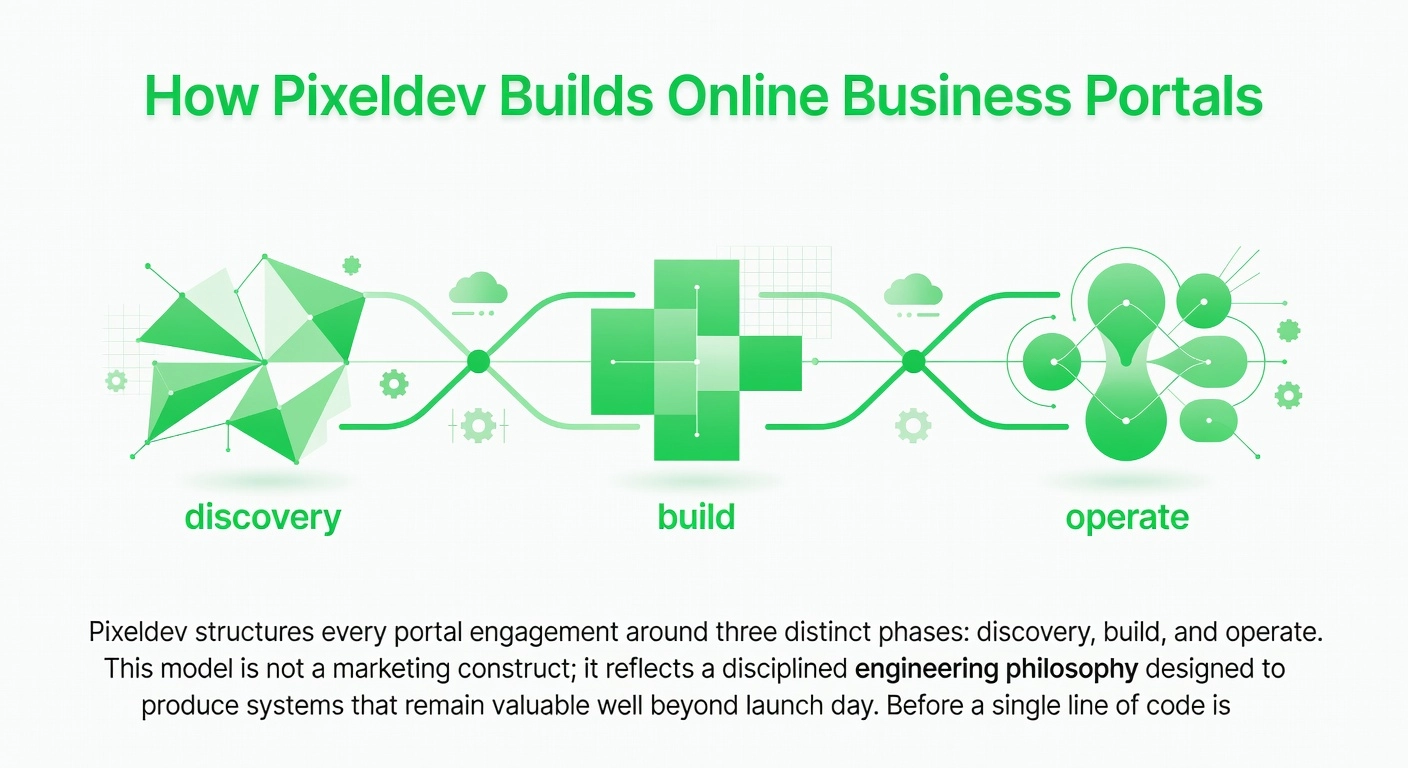
Pixeldev structures every portal engagement around three distinct phases: discovery, build, and operate. This model is not a marketing construct; it reflects a disciplined engineering philosophy designed to produce systems that remain valuable well beyond launch day.
Discovery First, Code Second
Before a single line of code is written, Pixeldev conducts a structured discovery process that maps user roles, defines integration requirements, documents existing workflows, and establishes measurable success criteria. This upfront investment matters because portal failures rarely stem from poor execution during development; they typically trace back to underspecified requirements and misaligned expectations set before the project began. By resolving ambiguity at the discovery stage, Pixeldev ensures the subsequent architecture is shaped around the actual business rather than retrofitted to a generic template. Client involvement and formal sign-off at key stages keep the engagement predictable and commercially accountable throughout.
Custom Architecture Across Every Budget
All portals Pixeldev delivers are custom-developed, meaning no off-the-shelf platform imposes constraints on what the business can build or how it can grow. Project scope spans a wide range, from indie launches and prototype builds starting under AUD 5,000 to seed-funded platforms exceeding AUD 150,000 depending on complexity, integrations, and team size. This flexibility reflects the practical reality that a first-time founder validating a customer portal concept has fundamentally different requirements than a scale-up deploying a multi-tenant B2B system. Iterative delivery through two-week sprints, weekly demos, and a live tracking portal keeps clients informed and gives them early visibility into working software rather than a single high-stakes reveal at project end. The Zeal Capital investor portal, which consolidated capital records, distributions, and documents into one secure custom system, illustrates how this approach handles real-world complexity.
Ongoing Support as Standard Practice
Post-launch, Pixeldev provides maintenance, security updates, performance monitoring, and iterative feature development under a structured support model. This directly addresses the total cost of ownership challenge that unmanaged portals create; annual maintenance typically consumes 15 to 25 percent of the original build cost, and poor maintainability can absorb up to 42 percent of ongoing developer time. Treating software as a continuous operational commitment rather than a closed project is central to Pixeldev’s positioning, and their published guidance on maintainability metrics reinforces this as an engineering discipline, not simply a support add-on.
Transparency as a Commercial Signal
Pixeldev publishes indicative project cost ranges in its public content, a practice uncommon among Australian portal development firms that typically require a conversation before revealing any budget guidance. For SME decision-makers and startup founders working within defined capital constraints, this transparency reduces friction and builds trust before the first meeting. Combined with a long-term partnership orientation that extends through retainers and lifecycle-focused scoping, the studio positions itself as a durable technical partner rather than a vendor whose engagement ends at deployment.
What to Prepare Before Starting Portal Development
Arriving at the development phase with incomplete preparation is one of the most reliable ways to inflate costs, extend timelines, and deliver a portal that underperforms against its original goals. Five foundational steps, completed before a single line of code is written, will determine whether your portal project succeeds or stalls.
Define your user types and roles with precision. Document every category of person who will access the portal, what actions each needs to perform, what data each should see, and where the permissions boundaries between groups must sit. A partner portal that accidentally exposes customer pricing to the wrong account tier, or an employee portal that grants finance data access to operational staff, creates security and compliance risks that are far more expensive to remediate post-launch than to prevent upfront. Start with core roles, map their workflows in detail, and validate those maps with actual users before architecture decisions are made.
Identify every critical integration before scoping begins. List each existing system the portal must connect to, whether that is a CRM, ERP, payment gateway, inventory platform, or third-party API, and document the data flows between them. Integrations routinely account for a significant share of both development complexity and post-launch maintenance burden. Validating API documentation, data formats, and sync requirements early prevents costly rework during the build phase.
Establish measurable success metrics upfront. Specific targets, such as reducing support ticket volume by 50%, compressing partner onboarding from two weeks to two days, or recovering employee hours lost to manual system switching, give the entire project objective direction. Without defined metrics, scoping becomes subjective and post-launch evaluation loses its basis.
Set realistic budget and timeline parameters. Use the cost benchmarks covered earlier as a starting framework and factor in annual maintenance costs, typically 15 to 20 percent of the initial build. Engaging a development partner for a scoped discovery session before committing to a full build budget is a well-established best practice that consistently reduces financial risk.
Audit your existing data and security posture. Portals that surface sensitive business, customer, or financial data require a baseline assessment of where that data lives, how it is structured, and what compliance obligations govern its handling. This audit directly informs encryption requirements, access controls, and architecture decisions that cannot be retrofitted affordably after launch.
Building a Portal That Grows With Your Business
A well-designed online business portal is a purpose-built, authenticated environment that does three things simultaneously: it reduces operational load through self-service, surfaces real-time data through system integration, and delivers measurable ROI that compounds as adoption grows. Customer portals alone reduce service tasks by approximately 63%, while employees reclaim roughly 25% of their working hours currently lost to fragmented systems. These are not marginal efficiency gains; they are structural improvements to how your business operates.
The decisions covered throughout this guide, including portal type selection, the custom versus off-the-shelf trade-off, realistic cost benchmarking, and post-launch maintainability, are interconnected. Getting one wrong typically amplifies risk across the others. A portal chosen for low upfront cost but limited extensibility will accumulate technical debt precisely when your business needs it to scale.
The most reliable path forward starts before any code is written. Define your user roles, map your key integrations, and establish success metrics through a structured discovery process. Then choose a development partner who offers ongoing support rather than a one-off handoff.
Pixeldev’s discovery, build, and operate model is structured around exactly this approach. A discovery conversation is a low-commitment first step to clarify your requirements and budget before any development commitment is made. Reach out to Pixeldev at pixeldev.com.au to begin that conversation.
Conclusion
Building an online business portal is not just a technical project; it is a strategic decision that can transform how your organization operates. The key takeaways are clear: a well-designed portal centralizes your core functions, delivers personalized experiences for every user, and eliminates the inefficiencies that hold growing businesses back.
The process requires thoughtful planning, the right technology stack, and a deep understanding of your stakeholders’ needs. When those elements align, your portal becomes more than a tool. It becomes a competitive advantage.
If your business is ready to stop managing disconnected systems and start operating from a unified digital foundation, now is the time to act. Begin by mapping your core workflows, identifying your users, and defining what a successful portal looks like for your organization. The investment you make today will drive efficiency, loyalty, and growth for years to come.