Software governance in enterprise: a practical guide
Software governance in enterprise is defined as the coordinated set of principles, policies, and practices that manage software delivery across the entire software development lifecycle (SDLC) to align with business objectives, risk management, security, and regulatory compliance. This is not a peripheral IT concern. For enterprise decision-makers and IT managers, it is the operating model that determines whether your software assets create value or accumulate liability. Frameworks like COBIT, NIST SSDF, and ISO/IEC 27001 provide the structural backbone, while practices like Software Bills of Materials (SBOMs) and Software Composition Analysis (SCA) deliver the operational visibility needed to manage today’s complex software supply chains. Getting this right is the difference between a controlled, compliant software estate and one that exposes your organisation to security breaches, licensing violations, and regulatory penalties.
What is software governance in enterprise?
Software governance in enterprise covers principles, policies, and practices across the SDLC to align delivery with business goals and manage risks, security, and compliance. The scope is broader than most IT managers initially assume. It spans strategic alignment, risk management, quality assurance, and compliance, touching every phase from initial design through to production operations and decommissioning.
The term “software governance” is sometimes used interchangeably with IT governance, but the distinction matters. IT governance addresses the broader management of technology assets and infrastructure. Software governance focuses specifically on how software is designed, built, tested, deployed, and maintained. Think of it as the discipline that answers: who decides what gets built, how it gets built securely, and how you prove it meets your obligations.

For Australian enterprises operating under frameworks like the Australian Privacy Act, the Notifiable Data Breaches scheme, or sector-specific regulations in finance and health, software governance is the mechanism that translates those legal obligations into engineering practice. The enterprise role of software documentation is one concrete example of how governance manifests in day-to-day software operations.
What are the key software governance frameworks?
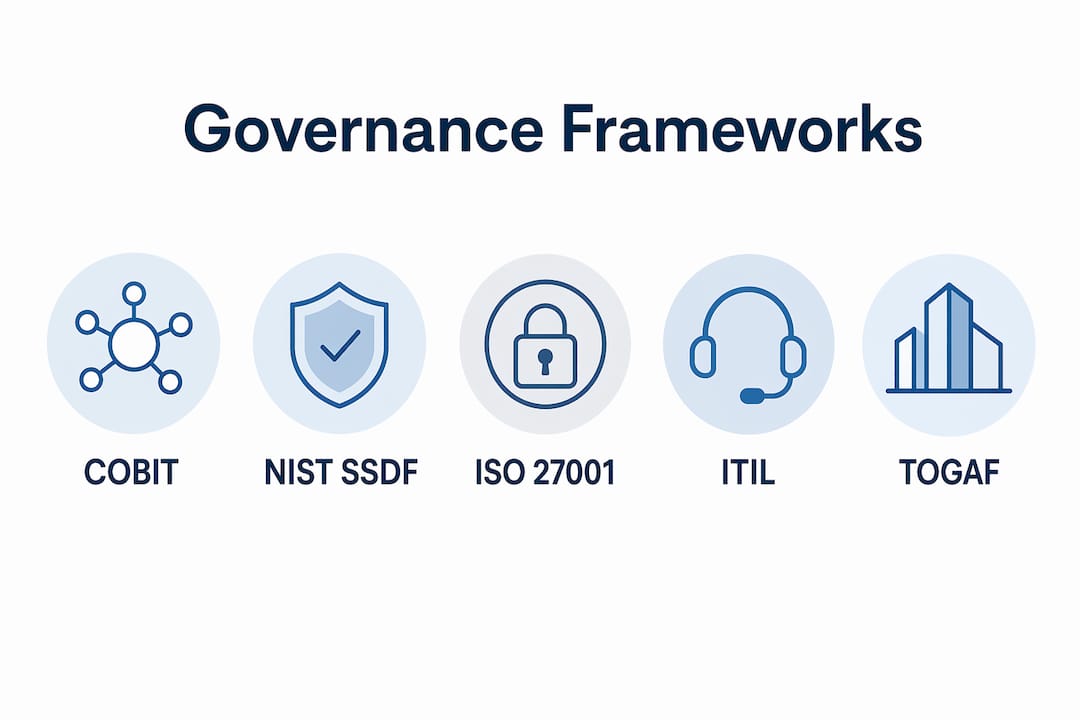
Key governance frameworks used in enterprises include COBIT, ITIL, TOGAF, NIST SSDF, and ISO/IEC 27001, often combined to meet business and security needs. No single framework covers every dimension of governance, which is why most mature enterprises operate with two or three in combination.
| Framework | Primary focus | Best used for |
|---|---|---|
| COBIT | Aligning IT processes with business risk | Enterprise-wide governance and audit readiness |
| NIST SSDF (SP 800-218) | Secure software development practices | Embedding security into SDLC phases |
| ISO/IEC 27001 | Information security management | Certification and regulatory compliance |
| ITIL | IT service management | Operational delivery and change management |
| TOGAF | Enterprise architecture | Aligning software architecture with business strategy |
COBIT is the most widely adopted starting point for enterprise governance because it maps business risks directly to IT processes. NIST SP 800-218, the Secure Software Development Framework, addresses a gap that most SDLC models leave open: most SDLC models lack explicit security practices, making SSDF recommendations critical for governance success. ISO/IEC 27001 adds the certification layer that regulators and enterprise clients increasingly require as proof of security management maturity.
TOGAF is less commonly discussed in governance conversations but is genuinely useful for large enterprises where software architecture decisions need to align with long-term business strategy. ITIL rounds out the picture by governing how software changes move through operational environments without disrupting service delivery.
Pro Tip: Start with COBIT to establish your governance baseline, then layer NIST SSDF on top to address secure development. Add ISO/IEC 27001 when you need external certification. Trying to implement all five frameworks simultaneously creates governance overhead that stalls engineering teams.
Understanding how software compliance requirements interact with these frameworks is the practical next step for IT managers building out their governance programme.
How do SBOMs and open-source governance strengthen enterprise software?
SBOMs provide inventory transparency for software supply chains throughout the SDLC and support risk-informed decision making and regulatory compliance. A Software Bill of Materials is essentially a machine-readable ingredient list for your software, cataloguing every component, library, and dependency along with version and licence information.
The challenge most enterprises face is not generating an SBOM. It is operationalising it. Many organisations produce SBOMs as a one-time release artefact and then treat the job as done. Governance success depends on integrating SBOM data into each SDLC phase rather than treating it as a one-time artefact at release. That means connecting SBOM outputs to your vulnerability management systems, your licence compliance processes, and your change management workflows continuously.
Open-source software (OSS) governance sits alongside SBOM management as a critical discipline. Without organisational OSS policies, risk and compliance gaps arise from developer discretion in open-source component selection. When individual developers choose OSS components without a policy framework, you end up with inconsistent licence obligations, unpatched vulnerabilities, and supply chain exposure that is invisible to your risk team.
Best practices for OSS governance in enterprise include:
- Establishing a formal OSS policy that defines approved licences, evaluation criteria for component trustworthiness, and a process for requesting exceptions
- Creating an Open Source Program Office (OSPO) to centralise OSS decision-making, track usage, and manage community contributions
- Deploying Software Composition Analysis tools such as OWASP Dependency-Check, Snyk, or Black Duck to continuously scan dependencies for known vulnerabilities
- Integrating SCA scans into your CI/CD pipeline so that new vulnerabilities are caught at the point of code commit, not at release
- Reviewing OSS component maturity, maintenance activity, and community health before adoption, not just licence type
Pro Tip: When evaluating an OSS component, check the time between the last reported CVE and the patch release. A project that takes six months to patch a critical vulnerability is a governance risk regardless of how popular it is.
What are the main challenges in enterprise software governance today?
Enterprise software governance fails most often not because of missing policies, but because governance is treated as a gatekeeping function rather than an operating model. Governance should be treated as an end-to-end operating model integrated into workflows, not merely a set of approval gates. When governance is reduced to sign-off checkpoints, engineering teams route around it, documentation becomes retrospective, and risk assessments lose their connection to actual system state.
The following challenges are the most common failure points for enterprise IT managers in 2026:
-
Static assessments in dynamic environments. Point-in-time security reviews and annual compliance audits cannot keep pace with continuous delivery pipelines. Modern software governance requires runtime visibility and continuous monitoring, because AI and automation increase attack surfaces and speeds of delivery.
-
The dual governance problem. Enterprises using third-party SaaS platforms or commercial software face a split between vendor compliance postures and their own internal controls. Your vendor may be SOC 2 certified, but that certification does not cover how their software integrates with your data or how their dependencies affect your SBOM.
-
Licence compliance blind spots. Open-source licence obligations, particularly copyleft licences like GPL, can create legal exposure when components are incorporated into proprietary products. Many enterprises discover these obligations during acquisition due diligence, which is the worst possible time.
-
AI-generated code governance. Development teams using GitHub Copilot, Amazon CodeWhisperer, or similar tools are introducing code whose provenance and licence status is ambiguous. Enterprises managing AI-enabled delivery pipelines require a governance control plane for continuous trust assessment, extending beyond one-time compliance checks.
-
SBOM operationalisation gaps. Producing an SBOM is a solved problem. Connecting it to real-time vulnerability feeds, enriching it with reachability analysis, and acting on it within your change management process is where most enterprises stall.
What are the best practices for effective software governance?
Effective governance models act as guardrails enabling productivity rather than bottlenecks, and the most successful implementations share a common characteristic: governance is embedded into engineering workflows rather than imposed on top of them.
The following practices define mature enterprise software governance:
- Embed SSDF practices into each SDLC phase. Map NIST SP 800-218 recommendations to your existing development stages. Threat modelling belongs in design. Static analysis belongs in the build pipeline. Penetration testing belongs before production release. Each practice has a natural home in the SDLC.
- Define OSS approval and evaluation criteria. Your internal OSS policy should specify which licence categories are pre-approved, which require legal review, and which are prohibited. Black Duck and FOSSA both offer licence classification databases that can automate much of this evaluation.
- Integrate SCA and SBOM tooling into CI/CD. Tools like Snyk, Mend, or Anchore can generate and update SBOMs automatically on each build, feeding results into your vulnerability management platform without manual intervention.
- Assign governance ownership clearly. Governance without accountable owners defaults to nobody’s responsibility. An OSPO handles open-source decisions. A security architecture function owns SDLC security controls. A compliance team owns regulatory mapping. These roles need defined mandates, not just job titles.
- Align governance cadence with delivery cadence. If your teams ship weekly, your governance reviews need to operate on the same rhythm. Quarterly governance reviews in a continuous delivery environment are structurally misaligned.
Pro Tip: The fastest way to get engineering teams to adopt governance practices is to make compliance the path of least resistance. Pre-approved component catalogues, automated licence checks, and self-service SBOM generation remove friction. Governance that requires manual effort at every step will be bypassed.
Reviewing application development workflow best practices gives IT managers a practical view of how these governance controls integrate into real development processes.
Key takeaways
Effective software governance in enterprise requires continuous integration of policies, frameworks, and tooling across every SDLC phase, not a set of approval gates applied at release.
| Point | Details |
|---|---|
| Define governance as an operating model | Treat governance as end-to-end workflow integration, not checkpoint approvals. |
| Combine frameworks deliberately | Use COBIT for business alignment, NIST SSDF for secure development, and ISO/IEC 27001 for certification. |
| Operationalise SBOMs continuously | Connect SBOM data to vulnerability feeds and change management at every build, not just at release. |
| Establish OSS policies before adoption | Define approved licences and evaluation criteria to prevent compliance blind spots from developer discretion. |
| Embed governance into engineering culture | Automate compliance checks in CI/CD pipelines so governance becomes the default path, not an obstacle. |
Governance as an enabler, not a constraint
After working with enterprise software teams across a range of industries, the pattern I see most often is this: organisations that treat governance as a compliance exercise produce documentation that satisfies auditors but does not reflect how software actually gets built. The teams that get it right treat governance as an engineering discipline.
The SBOM challenge is a good illustration. I have seen organisations invest in SBOM tooling, generate beautiful component inventories, and then do nothing with them because nobody owns the process of acting on the data. The tool is not the governance. The workflow around the tool is the governance.
The AI code generation question is the next frontier that most governance frameworks have not caught up with yet. When a developer uses GitHub Copilot to write a function, the provenance of that code is genuinely unclear. Existing SBOM standards do not yet have a clean answer for AI-generated code, and enterprises that are not thinking about this now will face it during their next audit cycle.
My honest view is that governance frameworks should be treated like sustainable software development principles: they are not constraints on what you can build, they are the conditions under which you can keep building reliably over time. The organisations that embed governance into their engineering culture, rather than bolting it on as a compliance layer, are the ones that ship faster with fewer incidents. That is not a coincidence.
— Liam
How Pixeldev builds governance-aligned software

Pixeldev designs and maintains custom software platforms with compliance and risk management built into the development process from day one. Every engagement covers the full project lifecycle, from architecture decisions that reflect your governance framework through to ongoing maintenance that keeps your system aligned with evolving security and regulatory requirements. If you are looking at examples of governance-aligned web applications to understand what well-governed software looks like in practice, Pixeldev’s work demonstrates how durable, maintainable platforms are built with these principles embedded, not retrofitted. For enterprises that need a development partner who understands the difference between shipping software and governing it, Pixeldev is worth a conversation.
FAQ
What is software governance in enterprise?
Software governance in enterprise is the structured set of principles, policies, and practices that manage software delivery across the SDLC to align with business objectives, risk management, security, and compliance. It covers everything from secure development practices to open-source licence management and regulatory reporting.
Which governance framework should an enterprise adopt first?
COBIT is the most practical starting point because it maps business risks directly to IT processes and provides an audit-ready structure. Enterprises with significant software development activity should layer NIST SSDF on top to address secure development practices within the SDLC.
What is an SBOM and why does it matter for governance?
A Software Bill of Materials is a machine-readable inventory of every component, library, and dependency in a software product, including version and licence data. SBOMs support risk-informed decision making and regulatory compliance by making software supply chain composition visible and auditable.
How does open-source software create governance risk?
Without a formal OSS policy, developers select open-source components based on individual preference, creating inconsistent licence obligations, unpatched vulnerabilities, and supply chain exposure. Copyleft licences like GPL can create legal obligations that only surface during acquisitions or audits.
How does AI-generated code affect software governance?
AI coding tools like GitHub Copilot introduce code whose provenance and licence status is ambiguous, which existing SBOM standards do not fully address. Enterprises using AI-enabled delivery pipelines require continuous trust assessment controls rather than one-time compliance checks to manage this emerging risk.